How Teaching has affected my Parenting

This post is a follow up to one I wrote about How Parenting has improved my Teaching. You may have noticed the absence of the verb “improve” in the title, this is at the request of my poor broken offspring.

1. I have a teacher voice

And I’m not afraid to use it, on my children, and even worse on other peoples’ children. My offspring live in constant terror that I will ask someone to pick up his litter, like I did the other day.

2. I also have a teacher look

It is useful for making small children cry, and getting “pleases” and “thank you”s from young people.

3. Every moment is a learning opportunity

Much to their joy terror. The other day my son said something like “I goed”, when I corrected him the whole family, including husband guffawed “ohh, get her, talking about irregular verbs and stuff at the table”

4. There’s NO excuse on the homework front

Rubbish like ” the teacher told us to note it but we don’t have to do it” gets VERY short shrift in this household, to the point where the kids do a bit extra just to get me off their backs.

There’s also no such thing as me writing a note or calling school to explain why tiddler shouldn’t get a detention because he forgot his PE kit. The kids wouldn’t dream of asking that, they know I’d probably phone and suggest a couple of extra hours’ sanction just to be on the safe side. In fact I have very little contact with their schools, their lives – their problems, deal with it.

5. Staying home sick doesn’t exist

I can’t, so they can’t either, end of story.

However I would like to think it’s not all that bad, apart from having dragged brought up a couple of pretty independent kids I like to remind them that

6. If I tell them not to wear that outfit it’s because it really isn’t cool

and I have expert knowledge of exactly how low your belt line should be and how high skirts are this week.

7. They have utmost respect for their teachers

My kids will NEVER ask a teacher if they’ve finished marking a test that was given a day ago, or even a week ago. They also know that any comment about attitude in their reports will not be appreciated.

8. Holiday homework books have no place in this house I’ve spent the whole year behind a marking pile, you don’t really expect me to spend the summer doing that too?

9. Holiday clubs are not for us We might be ready to strangle each other by week 4 of the hols but we WILL spend the school hols together, and there aren’t many working mums who can say the same thing, and that brings me to my final point…

10. Thanks to a summer with me, you’ll be REALLY looking forward to going back to school!
Posted in Uncategorized | 4 Comments

Creativity is like a bus…

… nothing happens for ages and then a load comes along all at once!

I’ve never considered myself particularly creative; can’t sing or play an instrument, can’t draw or paint, stopped writing poems for my granny when I was seven,…

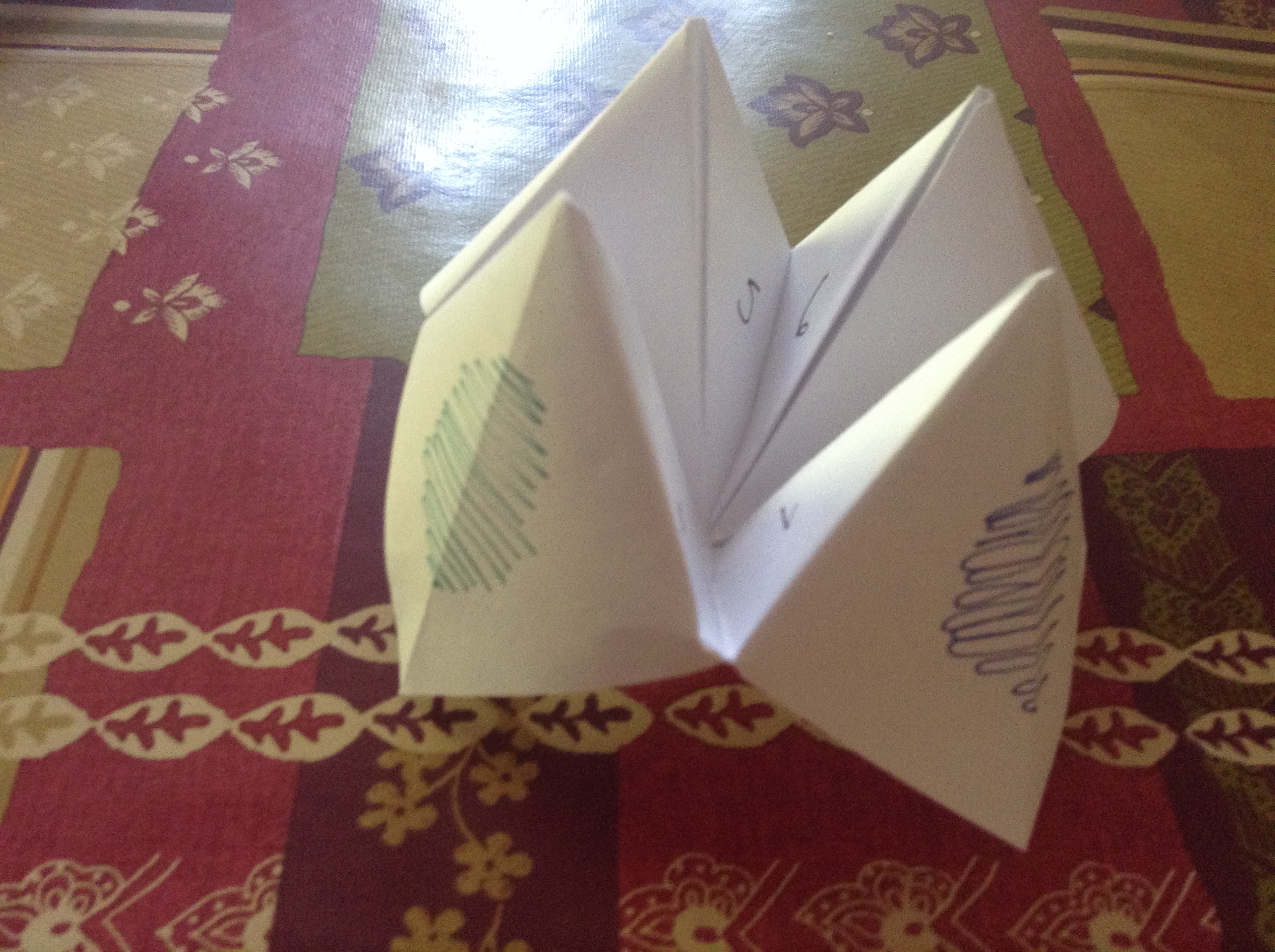
At an IATEFL workshop in Manchester this Spring we were asked to make something with a piece of paper, I made this…

IMG_3001

Young learners love making and playing them and they’re great for revising colours, numbers, giving orders, etc.

The lady sitting next to me exclaimed “ohh, how creative you are!” I had to bite my tongue not to correct her, after all; she’s entitled to her opinion.

That was my last brush with creativity until this week, when I’ve been buried alive under the stuff.

Firstly the teacherholics have been asked to edit the ETAS journal Special supplement on the subject next summer. In case you don’t know teacherholics is a group of teachers who meet about once a month in Geneva, the name came from my partner-in-crime Karen.

Then I came across the recent British Council publication, Creativity in the English Language Classroom which you can download for free, as I have done!

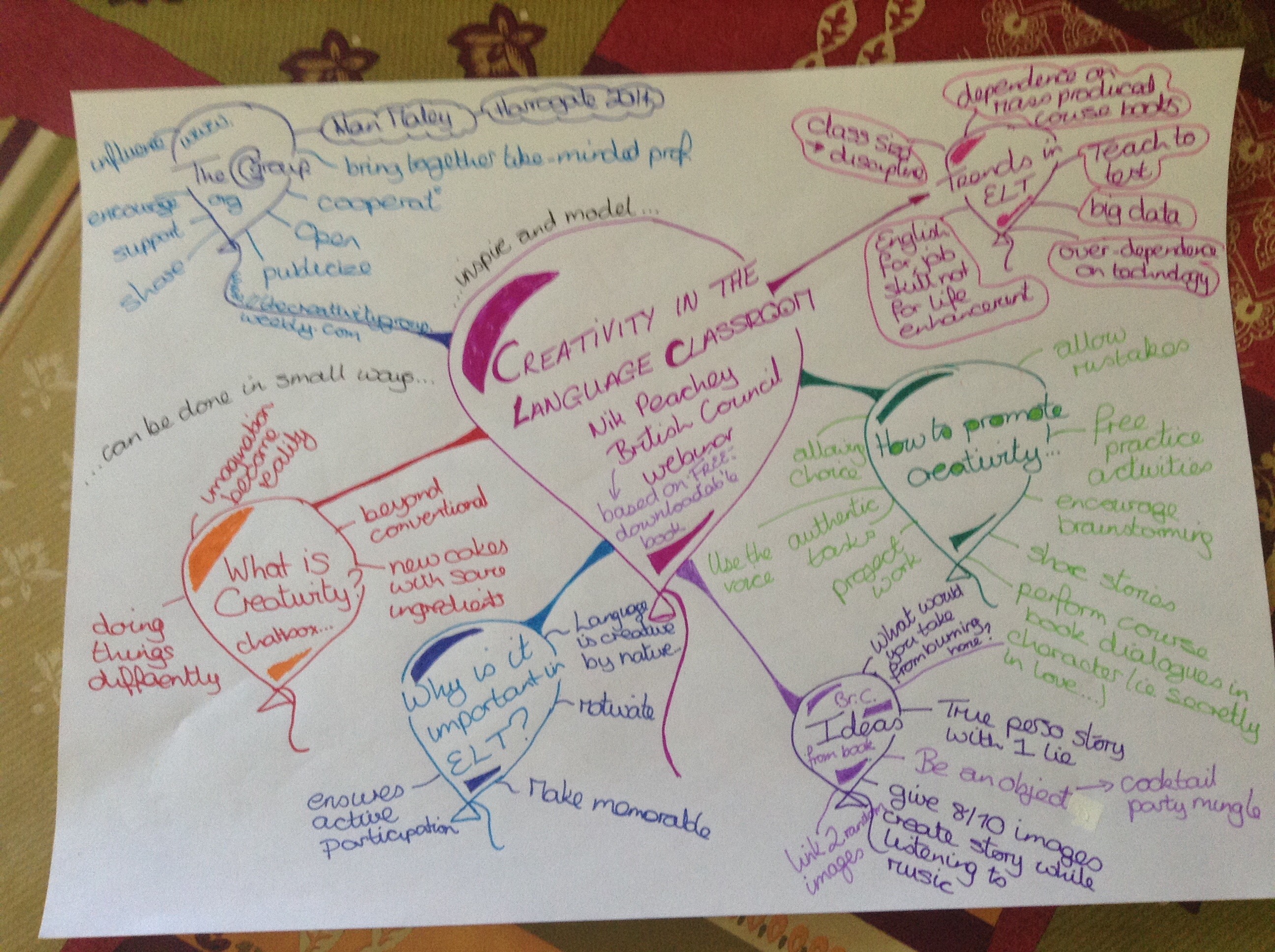
Yesterday I caught up on a couple of webinars, again on the subject of creativity, one was Nick Peachey’s and as I finally got the hint here’s a creative version of my notes:

FullSizeRender

As I mentioned, the British Council is full of the stuff, there’s Vicki Saumell’s blog and I particularly enjoyed Marisa Constandines‘ blog on 8 steps to becoming a more creative teacher. These steps are:

Become a knowledgeable teacher – I’m trying my best, reading her article must be helping!

Connect with other teachers – twitter I embrace thee! Not to mention ETAS, teacherholics and all that stuff.

Become a collector of teaching ideas – I have so many notebooks, pc bookmarks, etc littered about the place that I could use a new idea in every lesson until I die and still have some left over, not that I do… However I’ve taken to writing new ideas in my weekly lesson planner, so when I come across one I try it out.

Share your learning – doing exactly that here!

Remove the blocks to creative thinking – that one is tough, it’s easy to be surrounded by motivated thinkers in the twitter sphere, harder on a rainy Monday morning in the staffroom.

Practice your creativity – this is definitely new for me as I’m still not sure I have any, however as a start I’m going to pinch Charles Hanfield’s cool idea and write a poem everyday in my teaching journal, here’s today’s:

Sitting in the garden
The sweaty runner
gulping a glass of water,
thinking about Creativity.

Start experimenting and reflecting on your teaching –  this coming school year will definitely take place under the sign of CREATIVITY!-watch this space!

Make Creativity a daily goal – you bet!

OK, time to go, got to create…dinner!


Posted in Creativity, ETAS, teaching journal | 2 Comments

How Parenting has improved my Teaching

I recently came across a request to talk about this by @thosethatcan on twitter, so here’s my list:

1. I give clearer instructions

After watching my teen son run around like a headless chicken as he tried to comply to “pick your shoes up, clear your bedroom floor, have you emptied your bag?” all at the same time, I realised that there were more effective methods. So now at home, and at school if there’s more than one task to be completed I write a list, ticking off items is very motivating too!

2.I start as I mean to go on

My children starting secondary school and therefore moving into the age range that I teach was a real eye-opener for me, you mean English isn’t the only subject my students have to learn?!

Now I take it very slowly at the start of the school year, I set up procedures that I hope will become automatic, such as handing out worksheets ( a pile at the end of each row, then two seconds to pass down the row, then everyone waves theirs to show we’re all reading off the same page,) and ending the class (show and check everything is put away in the right place, write homework on board – and show the exercise and do the first one with them orally as an example).

3. I take an interest in my pupils’ lives

I’d like to think I always did but now my students and children are experiencing similar life events I have found it easier to bond with them.

4. I give advice on learning strategies for other subjects

As a mum who helps her kids learn for their tests, I have an idea on a few ways to do that and I share them with my class. It’s not rocket science (learn a little and often, not two hours at the last minute, etc.), they probably don’t listen, but then nor do my own children!

5. I can also give advice on more personal matters

Sometimes my students tell me about their personal problems, and my mum-perspective can help them see that things at home aren’t as black and white as they seem, maybe their parents don’t totally hate them after all?

and finally most importantly…

5. I totally rock on Star Wars, Transformers, Barca’s position in the league table and who Zoella is!

I realise this situation won’t last and as my children grow older than my students I’ll become one of those teachers who haven’t a clue about modern culture, but for the moment I’m like so cool, geddit!

Posted in #YL, teaching journal | 1 Comment

Webinar review – Charles Hadfield : Creative Grammar IATEFL

Another advantage of being an IATEFL member is being able to snuggle down of an afternoon and watch a webinar whenever I’ve got the time and inclination. I’d been meaning to watch this one for a while and was pleased to finally find time yesterday.

The cool but frustrating thing about watching recorded webinars is that I can also follow the chat box, but can’t join in. I saw a few familiar names up there (@ELTmethods, @trishiels, to name but a few), it was like tapping at a glass window when no-one can hear you – “hi guys, I’m here!”

Charles began by describing his training as a French teacher, using the “Question & Answer” technique, “is this an apple?” “No, it’s an orange” or more likely “why are you asking me such a stupid question? Are you blind?”

He described the stone wall difficulties he faced when he tried to introduce English Mother Tongue creative writing into a foreign language class.

Charles explained how, for him creativity may seem a contradiction to rule-based grammar teaching, but in fact all you need is 3 Imaginative Triggers:

-images
-brainstorming
– Joining two previously unrelated ideas together; suggested by Koestler in The Act of Creation (1964)

Reasons for using Creativity in the Grammar Classroom

1. Motivation
Language use is inherently creative, creativity encourages risk-taking, which is where the student expands his zone of proximal learning and increases his interlanguage.

2. Helps memorisation
The more cognitive energy that is used in produced language, the more effectively these new forms will be retained.

3. Role in L2 Identity
Personal input is essential in creating one’s L2 identity.

Charles went on to describe some creative activities that we got to try out, I particularly appreciated his details concerning level, timing, language, often not included in activity ideas (You can see more details if you are an IATEFL member on his slides on the IATEFL webinars page):

  1. Platform 17

We were shown a couple of picture prompts and given the following poem frame-

Line 1- Where?
Line 2 – A (adjective) (person)
Line 3 – What are they doing?
Line 4 – What are they thinking of?

I ignored the prompt and wrote my own:

CPD

Slouched on her bed
A tired teacher with holiday hair
Watching a webinar
Thinking of school

As Charles mentioned, writing to a pattern encourages the use of certain language, and in my opinion it allows the creation of great “poems”, even if like me, you don’t have a creative bone in your body.

  1. How It’s Done

Write slips of paper to be chosen by students or groups, including activities such as eating spaghetti, getting promoted, bathing a dog. You can be as mundane (making a cup of tea) or quirky (falling in love) as the situation requires. Then ask the students to write a list of instructions – le voilà! – plenty of imperative practice!

Marjorie Rosenberg took the words out of my mind when she suggested a variant of this in the chatbox; get the students to read out their instruction list and the rest of the class guess the activity.

3. Prepositions painting

Create a table such as

On                                      table
In                                       chair
At                   a/n              desk              lies a /n
Under            the               bench             is a/n
Next to
Beneath
Beside

and allow the students to create poems such as…

On a bench
Next to a tree
Beside a lake
Beneath the mountains
Under a sunset sky
Lies a…

and get the student to imagine the item in question!

4.Maternal Advice

Charles read us a section from Jennie by Paul Gallico, where a mother cat gives advice to her offspring, we then had a great time imagining advice from various other animals to their children.

5. Overheard in a Café

In this activity we were shown various portraits and had to choose a couple of them and imagine overhearing their conversation. This is a great way of practicing reported speech, which my students find quite complicated. Teaching teens I would tweak this activity by using photos of famous people of couples such as William & Kate, Kayne & Kim and have the students report their conversations instead.

6. This is the house that Jack built

Charles showed us a photo a man on a boat who had caught an enormous fish, creating follow-on phrases such as “this is the girl who cooked the fish that Jack caught” is a great way to practice relative clauses, and with the adde competitive element (longest phrase wins!) this is a guaranteed crowd-pleaser!

I agree when Charles encourages us to publish all this wonderful work produced by our students in some form or other, wall display, blog, school magazine. All this creativity is not just for practicing English grammar but also has a major role in encouraging students’ self esteem and building self confidence.

To conclude…

A well organised and highly effective webinar, while I’m interested in current theory it’s definitely the best practice ideas that I find most useful, and I’m sure I’ll be using some of these next term in class.

Posted in #YL, Fab ideas, Fab YL ideas, Reviews | Tagged , , , | 5 Comments

How my other life helps my teaching

It’s the holidays, woop woop!

This means I can do loads of other stuff and don’t have to think about teaching for ages.

This means I’m thinking a lot about teaching and coming up with some great ideas for next year. It also got me thinking about how all the other things I get up to away from the classroom affect my teaching.

Mindlessly surfing the internet

While it may seem to my husband the bystander that I’m just mindlessly surfing, I am in fact picking up great ideas from a plethora of sources, first of which on my list would be my twitter feed and places like edutopia or the British Council.

Running

Even during the school year I always come up with the best solutions and ideas while out running, it’s a pity that I forget them all in the shower! I read a quote recently about someone saying they ran for “sanity and vanity” and then definitely describes my running; jogging round our local woods exercises my mad dog, clears my brain and stops me snapping (quite so much!) at my family, the added bonus is the extra ice-creams I can eat guilt-free!

I have noticed however that as well as time to think through what’s going on in the grey matter, running also gives me the mental and physical stamina necessary to keep going during a long teaching day.

Volunteering

Having just recently organised our annual village race for around three hundred participants, I can tell you that dealing with about sixty volunteers, not to mention the inscriptions, barbecue, race wardens, Red Cross and the paperwork has taught me an AWFUL LOT! Not least dealing with the prefecture’s (county council) requirements for the heatwave we have found ourselves in recently.

I have learnt patience, determinism and more importantly the simple fact that in order to get people to do what you want, the thing that works best is… wait for this…

Being REALLY nice to them and saying THANK YOU a lot.

You wouldn’t believe how many meetings/ events I’ve turned up at to have someone yell at the few people who have shown up about how there’s not enough people to help, or sat through someone’s rant about how “it’s always the same people who have to do everything” (not surprising there’s no new blood if all you do is moan at them) or even worse, “if you want something doing properly you need to it yourself” (or patiently explain to someone else and help them learn how to do it?)

It may seem blatantly obvious to us, but it’s not to everyone believe me, you can get much more out of people with a positive, friendly attitude, be that chair-lifters or students.

Organisation

This is so hypercritical of me that I’m blushing as I write, as I’m the most unorganised person in the univers, however when up to your eyes in mails and paperwork, on whatever subject, it really helps to tag and file those mails so you can find them again, be it a promise of an ambulance for the security tent or a query from a parent. I would add the to-do list in this section; this cunning device has enabled me to get a good night’s sleep in the weeks before the race.

Of course it works the other way round too, everything I’ve learnt through teaching comes in useful elsewhere, for example I was the only race volunteer who could go the whole morning without a toilet break!

Posted in Uncategorized | Leave a comment

Writing your Conference Proposal

A lot has been said about this before, here for example, and elsewhere on this blog, for example here, however here are some more personal thoughts on the subject.

Think about what you want to do

Go for a walk somewhere nice and have a think about what you want to say, and especially – how are you going to say it, take your time – mull over your ideas until one of them just goes “click”

A talk is usually shorter than a workshop, and although a workshop should include more “audience participation” than a talk it’s nice to give everyone a chance to at least say hello to their neighbour.

Choose a subject you are PASSIONATE about!

Not only will you shine with enthusiasm during your presentation but as you are going to be working on this subject for a while (we all hope!) including when you practice (which you will !) and repeat yourself endlessly then it had better be something you believed in.

Don’t try and guess what will be the “in” subject

Even if you could predict the future would you choose a subject everyone will be talking about or avoid it for something more original?

Be Practical!

I realise that this is a very personal opinion, but I really think that most teachers (and by that  mean me!) would rather take away some new ideas to use in their classrooms than hear about some detailed research you have undertaken, unless of course there are some obviously useful tips teachers can integrate into their lessons.

Enjoy it!

Remember the buzz you get from stepping outside your comfort zone? This is really your chance to put yourself on the line, the best way to learn is to teach so giving a presentation is the ideal way of perfecting whatever you are going to talk about.

What advice would you add?

Posted in Conferences | Leave a comment

To run far, run together

Today has been a wonderful day, the biggest news is OUR BABY HAS ARRIVED!!

baby!

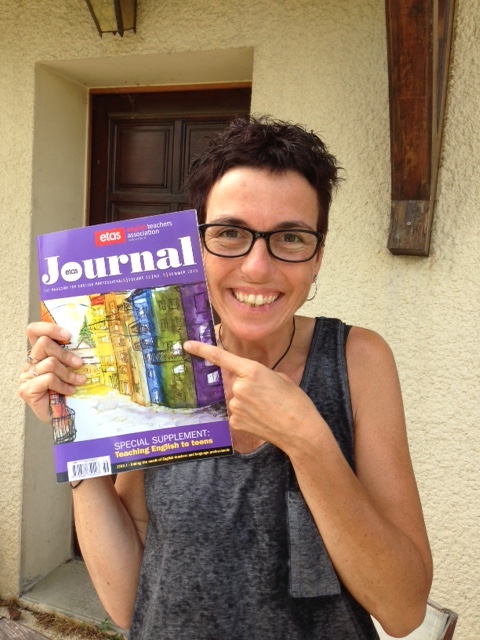
I’m soooo proud of this journal, especially the special supplement “Teaching English to Teens” that I helped to put together. Not only did I get to interview HERBERT PUCHTA (*squeak of excitement*) but more importantly I met/got to know better a fantastic group of people at ETAS;

etasgang

Not forgetting the amazing Urs Kalberer,Teacher development chair at ETAS.

Earlier I went for lunch with my partner-in-crime, Karen Greaney; as well as being a great friend, Karen is ETAS Geneva regional coordinator with me. (I have lots of photos of Karen but she’ll kill me if I post them!)

You’d be forgiven for thinking I don’t actually have a job, but I do – with the most fantastic colleagues, including Florian;

flo

I’m mean about him I make jokes about him in front of the students who think it’s really funny, and I’m know he does the same. However, when the going gets tough there’s no one I’d rather have in my corner.

I also managed to fit in a run this afternoon, and as I was straggling behind I thought about the popular saying- “To run fast, run alone, to run far, run together” It’s so true, training and running a marathon is definitely a team effort, when the going gets tough, you want to slow down or find an excuse to stop, then the team  pulls you forward. When your team-mate falters then it’s your turn to take up the slack.

So this medal is for my team, thank you all for being there, thanks to your support I’m ready to keep the pace now.

IMG_2991

Who’s in YOUR team?

Posted in teaching journal | Tagged | 3 Comments

A letter to my #youngerteacherself

A while ago I read Joanna Malefaki’s letter to my younger teacher self and she’s just asked me to write mine (thanks Jo, great idea!) so here goes:

Dear Rachael,

Congratulations! You’ve just got yourself the best career in the world, maybe not the best job just yet, but don’t worry that’s coming. Here are a few tips to get yourself ready for when that job comes around; by “ready” I mean still mentally and physically fit enough to take, and enjoy it!

1. You can’t take everyone with you

You’ve recently been told this by a colleague, and you don’t believe her, you still think “nobody gets left behind in my class”, but believe me, you cannot stay on the present simple until everyone in the class remembers that god-damn  “-s” time. Remember how she said all she aimed for was a class of kids who loved English? Well, she’s right. Also soon you’ll start reading theory on Language Acquisition Order and see that it’s not going to happen until they’re ready anyway.

2. Join IATEFL and a local teachers group ASAP

I know internet is just developing (my God, you’re that old?!!) but get a network and learn from it. Also start a reflective journal, I’d love to be able to re-read it now!

3. Avoid the mood hoovers

Staffrooms, especially in secondary schools, are full of them, beware! – and remember NEVER sit in anyone’s armchair, or take a coffee mug without checking it’s communal!

4. Be yourself!

It’s tempting to tell you things like do a DELTA, or don’t wait 20 years before starting your MA, or stop smoking and cut down on the late nights, but I guess you won’t listen, I know what a stubborn moo you can be! Anyway all those errors and adventures made you who you are today, and it’s not that bad! (Although while we’re on the subject, when you change from teaching lower-secondary to post-A levels, wait just a little bit longer before throwing out all your material, remember – that dream job is just around the corner!)

Anyway, look after yourself – if only for me!

Rachael!

P.S. – That French guy? – It might not be just a holiday romance!


Posted in teaching journal | 7 Comments

An ode to apps

I have this fantastic class on a Monday and Tuesday afternoon; the AEP (Advanced English Programme), or the “anglophones” are they are known to the rest of the school. This is when all the native English speakers, the kids whose parents think they are English mother tongue, and a handful of really motivated L2 speakers get together to do…

…whatever we want!

Well, whatever I want actually. There’s no official programme, no end of year exam, as long as nobody or nothing is damaged then we can do what we like to improve ourEnglish and learn about the world.

As you can imagine, it’s a fun class to teach, we’ve done lots of stuff this year, here’s the programme I “followed” this year. The final production was a group project on the subject of their choice.

After choosing a subject that interested them and researching some answers they studied different ways of producing their newly discovered information; this is where Joe Dale’s great talk at IATEFL’s YL pre-sig event came in very useful, he presented variety of apps that I have previously mentioned.

you can see Joe’s IATEFL interview here and follow him on twitter here.

There are loads of advantages to using apps like the ones Joe presented in the classroom, not only are students motivated and the lessons “fun” , but for me one of the best things is that I’m able to publish fantastic student work without having to worry about privacy issues.

Here’s an example of what I mean:

As this class is for all the students aged 9-15 some of them will be with us for the next six years if they are lucky!! This is even better as it encourages me to try new stuff all the time, no risk of repeating something we did last year.

As for next year’s programme, in our last lesson I asked all the students to fill out a syllabus sheet for me; individually or in groups they filled in the year’s 36 x2hours of lessons on a grid, with explanations and links where necessary. I can’t wait to find out what we’ll be doing!

Posted in Uncategorized | Leave a comment

Activating Language

Another quick idea on how to literally warm up students’ language, simply give them a pen each and create a wordmap:


Posted in Fab YL ideas | Tagged | Leave a comment