Some dyslexia myths debunked

  1. Dyslexia doesn’t exist:

Also known as “Dyslexia is a load of rubbish; invented so middle class parents have an excuse when their kids fail their exams.”

Thankfully few people actually believe this now, although I do unfortunately know some, even teachers. They’re usually the old-school kind of teachers that say this kind of thing;

“Our youth now love luxury. They have bad manners, contempt for authority; they show disrespect for their elders and love chatter in place of exercise; they no longer rise when elders enter the room; they contradict their parents, chatter before company; gobble up their food and tyrannize their teachers”

This quote was falsely credited to Socrates, who died  in 399BC), but even so, you know what I mean!

It would probably be more helpful to talk of a dyslexic spectrum as not all dyslexics have all the symptoms associated with dyslexia, which means things can be a bit vague, and a report I read recently (sorry can’t remember where!) suggested we shouldn’t talk about “dyslexia” as one size does not fit all and it’s not necessarily helpful to pigeon hole students.

  1. Dyslexia affects more boys than girls.

Yes, and No!

The American dyslexia association claims that approximately 8-13% of girls have been diagnosed, whereas 18-22% of boys have been. However we should remember that boys in trouble make trouble, whereas girls often quietly drown, or work extremely hard to get by.

  1. 1 child in 10 has some form of dyslexia.

This is about the figure given by most associations, Schneider talks about 2-5 children being dyslexic in a typical class of 20-25 pupils.

  1. Dyslexia is genetic.

If a boy has a dyslexic father he has about 40% chance of being dyslexic himself (Gilger 1991), and this figure can rise to 100% if both parents are concerned. However the nuture vs nature debate is present here, in a house with dyslexic parents a child is probably not going to be presented with the image of his parents constantly with their noses in books (as I was) or necessarily be read regular bedtime stories for example.

It is interesting to note that the “dyslexic” gene has been discovered in chromosome 6, also home to genes responsible for autoimmune diseases.

  1. Dyslexia is a visual problem.

Some dyslexic people are affected by Meares-Irlen syndrome, this is where sufferers are affected by the glare of the contrast between black ink and white paper, this results in eye strain and eventually loss of concentration and reduced focus.

  1. Dyslexia is a neural problem – you can see if someone is dyslexic by looking at an MRI scan of their brains.

Cells found in the neural tract between the retina and the visual cortex, one – the magnocells are found to be damaged in the case of dyslexic children tested. These cells send information relative to contrast and movement, when we read our eyes don’t smoothly follow the words along the page from left to right, they jump back and forth at great speed – these jumps are known as saccades, and the magnocells are responsible for seeing “round” these jumps and for our vision of contrast. This would explain why some dyslexic children complain about letters moving around the page.

The cerebellar deficit hypothesis: this suggests that the lack of automacity seen in many dyslexic people is caused by damage to the cerebellum.

The hemispheric symmetry hypothesis : less activity in the left hemisphere has been seen when dyslexic students have had brain scans preformed while reading, as you know the left side is the area that is responsible for language.

  1. If you are dyslexic then you probably suffer from ADHD or dyspraxia.

Yes, according to the U.S. dyslexia association approximately 40% of dyslexic pupils also have another SEN, or specific educational need, for example ADHD (logical really if you think that it requires five times more effort and energy for a dyslexic students to perform the same standard of work as his classmates), dyscalculia, dyspraxia, and especially dysorthography.

  1. Some languages have more dyslexic speakers than others.

No, dyslexia exists in every language and in every alphabet, including Mandarin and Cyrillic languages. However some languages, such as Italian are more orthographically and phonetically consistent so dyslexia is not necessarily spotted, or considered a problem until later on, when reading speed becomes an issue. English is very orthographically inconsistent and therefore difficult, not only as a mother tongue, but especially as a foreign language.

  1. Dyslexia is simply bad spelling and slow reading.

No!! While it is characterized by difficulties in phonological processing, which meands sufferers can’t easily recognize sounds in words or quickly represent those sounds with letters, it is in fact much more than this;

  • many dyslexics have working memory difficulties, this makes activities such as copying notes from the board very challenging, or remembering instructions.
  • Some have auditory difficulties such as glue ear, and find it hard to discriminate between separate words ( one of the reasons that young dyslexics have trouble learning nursery rhymes).
  • A discrepancy between IQ/general intelligence and reading level is often one of the signs of dyslexia.
  • Sequencing can be difficult, so activities such as putting the pictures in the order that they occur in a text will be challenging.
  • The speed of processing information can be affected, which is why dyslexics need more time to do the same tasks as classmates.
  • Reading comprehension, even after the text has been deciphered, is not necessarily a simple task.
  • Low self-esteem is one of the most common, and in my opinion, serious symptoms of dyslexia, these kids are constantly failing to achieve what is expected of them at school, and eventually they will give up without the support that they need.

10. People with are creative genius

Yes, and no!  As mentioned earlier, dyslexic people often use the right hemisphere of the brain more than the rest of us, this side of the brain is responsible for creativity, and lateral thinking. They tend to be more holistic than linear thinkers, and at a time when thinking outside the box is what employers are looking for, this is great! Books such as “The Dyslexic advantage” mention this and many other good things about being dyslexic.

However, as is ever the case with dyslexia, these are not “one size fits all” boxes, someone may be considered dyslexic but not have any visual problems, or genetic links, or not be particularly creative, and as has been recently pointed out to me, if you say that all dyslexic people are particularly creative, then a dyslexic student who is not will feel doubly hard done by.

I hope these comments have helped you form your own opinions, and made you curious enough to look for the answers elsewhere, I am by no means an expert, and studying dyslexia and other learning difficulties from the edge of Switzerland and France sometimes feels like an uphill struggle, in a school system that has only recently recognised many specific educational needs and where SENcos don’t exist, this is a far cry from places like the UK, which have so many wonderful things in place for learners.

I realise that some people consider “dyslexic” as a negative, or at least overly simplistic term, as it does very little to actually define how to help a particular student, however in my experience students are fine with being described as dyslexic, for them it explains why they think and learn differently to their classmates, they are relieved to discover why they find somethings so difficult, and that is a first step to finding solutions for their learning needs.

Please don’t hesitate to inform me of any useful articles or texts that can help me improve my view on dyslexia, or indeed any other learning difficulties, like you, my main objective is to become a better teacher – to all of my students.


Posted in Special Educational Needs | Leave a comment

Reflective Teaching Challenge day 7 – What I learnt from an inspirational colleague

When I became a replacement teacher in a relatively challenging secondary school it was my first experience teaching teens. 

I was almost eaten alive, discipline was a nightmare. 

I think I was saved by the fact that the kids realised I could actually speak and teach English, if only they’d be quiet enough to let me.

Also, I was the only English teacher that had that didn’t have to take time of for a nervous breakdown.

Young and naïve that I was I insisted that no one would get left behind, then followed ten weeks of games and exercises on the verb to be, the rest of the class patiently (at first) waiting for Johnny, who was clever enough to realise that things would get much harder if he ever gave in and got something right.

Talking about this in the staffroom, one colleague’s comment has stuck with me ever since;

“I don’t bother about what they’ve learnt or not, as long as they say they like English at the end of the year, then I know I’ve succeeded.”

At the time I was shocked and vowed I’d never be like that, then I went back to my classroom for a few more fun things to do with “BE”.

Only fools never change their minds. More and more I see that students can’t/won’t learn if they’re not comfortable and at ease in the classroom, as a student myself I can see that learning things I enjoy is much easier, and that relentlessly beating away at the same grammar point is not enjoyable, being challenged is.

Interestingly Scrivener has been talking recently about demanding high, and I find that the more you expect of your students ( to an extent), the more they will step up to the mark, and the more self confidence they develop in their English.

I’m not in touch with this colleague any more, but I wish I was, I’d tell her that my students love their classes now, that they are challenged and interested in their learning, and even if they don’t get it all now, they will soon, because they love English.

Posted in teaching journal | Leave a comment

Reflective Teaching Challenge day 5 – What does a good mentor do?

A difficult question because sadly I’ve never really had a mentor, once I’d done my CELTA I started work for someone who was willing to give me a lot of independence, and didn’t have the time to do much mentoring. Later I worked in secondary schools where the mentality was along the lines of  ” I’m not sharing that idea/book as it’s MINE” or in business schools where I was the only English teacher.

It’s only recently I’ve developed any kind of mentoring relationship, although it’s more of a mutual help and support thing with a few colleagues. It has helped me see how I would try to be if I was someone’s mentor:

– Ask and Listen, how was your day/lesson, what would you change?…

-Share, material, ideas, websites, worries and questions.

– Encourage others to find their own solutions, “ah, I had a class like that, I remember, it was in 1996, I did X and Z with them”, not much help I don’t think.

– Encourage reflective teaching, share a journal, watch each other’s classes or videos of classes.

Tell me about your mentor.


Posted in teaching journal | Leave a comment

Reflective Teaching Challenge day 4 – What do you love most about teaching?

Wow, great question, I could ramble on about this for hours, and frequently do, although I’m trying to curb this habit as even my colleagues find me boring!

So, I’ll be brief…

What I love most about my job is the chance to spend all day in the company of hundreds of fascinating people. Not all together at once, thankfully, but in total I have almost a hundred students, and all of them are the most interesting, original people. I love finding what makes them tick, and trying to discover ways of making them love learning English.

I have a lot of great colleagues who think the same way,

I have a lot of independence when it comes to curriculum and book choice,

I get to go on cool school trips, Naples, Edinburgh, local park, via ferrata, you name it, I’m always game,

teaching English isn’t like teaching other subjects, we can do ANYTHING in class if we do it in English, making films, performing plays, etc.

I’m rambling aren’t I?!

Posted in teaching journal | Leave a comment

Reflective Teaching Challenge day 3 – An “observation” to improve for your teacher evaluation.

Mmm, an interesting one that, a few things come to mind but I’ll go with this comment a colleague made when she observed my classes last term-

During the Teacher-Student phase of the lesson I tend to pick the same students to answer all the time, these are the ones sitting in my “teaching zone”, that is row two & three, middle and slightly right. the students at the front, left side of the class can have a nice nap to be honest!

I know I’m doing it and after a nice chat with the favoured group I will fling a few questions around the room, so I can safely say everyone has participated something to the day’s lesson. 

I justify this by saying I ask the students I know can and want to answer, not wanting to ask the others questions they might not be able to answer.

However that doesn’t make it right.

So this is what I’m going to try and do:

1) I’m going to write up some questions on the board, maybe while the students are doing a written exercise for example, so they have time to think of their answer.

2) I will tell them they must ALL put their hand up three times during the lesson.`

3) When asking a few students the same question, I will give the order of questioning for some of them, “I’m going to ask John, then Claire, and then you Jo”, for example.

4) It’s tempting to move the students so the ones having a break before are now in the limelight, but I’m not sure if it’s fair to make them sit somewhere they won’t be comfortable, what do you think?

Have you any other ideas to help me?


Posted in teaching journal | 1 Comment

Reflective Teaching Challenge day 2 – A piece of technology I will try this year

I’m not averse to technology in the classroom, think I use my iPad in class more than my board pen. Not only do I upload the lesson plan and homework at the end of every lesson but there’s always something to google, like earlier today when we asked ourselves what the largest island was (it’s Greenland) and why it wasn’t Australia, which is much bigger (because it’s a landmass, not an island, go figure!)

I also use apps like Bitsboard and sock puppets, as well as Grammar in Use for revision.

So, what new technology will I try this year? I suppose I should say the smart board, which hangs there, miffed at being used as a projector instead of using all the great software programmes that were advertised at our training day.

Instead I’ll choose the following : creating an app.

The reason I’ve chosen this is that I have included it in the programme of my advanced class! I quite like doing that, pushing myself to discover new things by teaching them to others. The other advantage of doing things this way, is that as I am totally honest to my students (about this kind of thing anyway!) they will have to discover how to create an app, so they can teach me how to do it!

If you want to find out how we get on, watch this space!


Posted in teaching journal | Leave a comment

What is it? Where is it?

A fun activity to break the ice at the beginning of term and revise directions and prepositions of place.

I went to the local park a couple of days ago and took some interesting photos:

IMG_1521-1.JPG

IMG_1505.JPG

IMG_1537-0.JPG

The students got into groups and each group was given five photos and had to go and discover where they were taken and what the object actually was.

Posted in Fab ideas | Tagged | Leave a comment

Reflective teaching challenge day 1-Goals for this school year

Wandering about twitter the other day I cam across this fantastic idea from @teachthought and I thought it would be just the thing to kick start some reflective thinking this term.

Then I went back to work and my feet haven’t hit the floor since, luckily I had clean clothes lined up and I just about squeezed in time for the odd shower, I may have eaten, but I’ll be damned if I remember what. 

Why does “back to work” hit so hard? How did we manage before? I suppose we’ll get used to it, by the time my tan has faded I’ll have got into automatic gear.

In the meantime it seems all the more important to take up this challenge, otherwise a whole month will have wizzed by before I have time to think about it again, so here goes;

DAY 1 – Goals for the school year

Oh my, I’m sol glad you asked me that one, I have so many exciting things lined up.

Firstly I’ve joined the editorial board of the amazing ETAS, the English Teachers’ Association of Switzerland ( Iive about 15km from the border in case you were wondering why!). I will be helping proofread and finding articles for their journal. I’m especially looking forward to helping with the special supplement on teens.

Workshops – so far I’m giving one in September at the ETAS PD day, on dyslexia in the classroom, and another one on the use of L1 at the TESOL France conference in November.

CPD – while the above can be counted as professional development I’ll also be continuing my M.A. TESOL that I started last year with Sheffield Hallam, depute the deadline stress I really enjoyed this course and am looking forward to continuing it, and doing more classroom research to fulfil its requirements.

After the amazing time I had last year at IATEFL Harrogate, I’ve already booked my place for IATEFL 2015 – Manchester, can’t wait, and to keep me going there’s the IATEFL web conference and plenty of webinars to watch out for.

In between all this stuff I hope I’ll find time for my classes! Actually I’ve got some fun things lined up already, especially for the Avanced English Programme I’ve set up for some of my students.

Finally, this morning I came across theTED ed club, which gives you resources to start and run a TED ed club in your school, I’ll keep an eye on it but I’m not sure I’ll have a suitable class to use it with this year.

Anyway, that’s more than enough to motivate me this year, I’ll just have to find a marathon or two to run and I’ll be sorted!

What about you, why not share you plans and goals for this new school year?

Posted in teaching journal | Leave a comment

Teaching Creative Writing to Dyslexic Students

If the title itself sounds like the TEFL equivalent of a 12 metre fence to be jumped, remember that your students will be even more frightened than you are!

It’s a pity, because often dyslexic students are holistic learners with great imaginations, with a little help they can produce some great work, and  more importantly, enjoy doing so. Here are some ideas to help you and your students.

-Preparation:

Many students need a little longer to collect their ideas on a given subject, so give the topic for homework, or post it on the class blog so students who wish to can prepare some thoughts or vocabulary before the lesson.

Some students prefer to draw scenes of their story before describing them with words and bring these drawings to class, this not only provokes an interesting discussion on the subject but also allows some students to demonstrate one of their strengths in a place where unfortunately it is rarely the case.

At the start of the lesson use these and other visual resources to encourage brainstorming in pairs.

If you choose your pairs carefully then this part of the lesson actually becomes a form of informal peer tutoring.

-Organisation:

To help students organise their ideas in a visual way  encourage them to produce a mindmap®, the various sections can then form paragraphs later.

Offer students a writing framework, with checklists including, for example: who? When? Where? What happened? Describe what you can see, smell, hear, or feel. Some frameworks include paragraph titles, first and last line, keywords and connectors that must be used, etc.

Sometimes you can give out these lists but it can be motivating to come to a group agreement about what to include.

-Production:

If you are lucky enough to be able to allow word processors in the classroom then there is a lot of great software available. Programmes such as Texthelp® and iReadWrite® have features that include word prediction to help students find the word they are looking for, phonetic spellchecks, definitions for homophones, image dictionaries and the possibility of reading the finished text ( or any other imported text) aloud.

Even with no special software, changing the background colour to a pastel shade and avoiding black ink can help, as can using a dyslexia-friendly font such as open Dyslexia, or the more commonly used Comic sans or Times New Roman.

If this material cannot be used in class then perhaps students could complete the work at home, this also removes the stress of having to complete the work within a given time.

If the writing is to be done in class, there are still opportunities to support dyslexic students, offering a scribe can be detrimental to self-esteem, but pair writing can overcome this, with one student providing more work in terms of preparation and ideas and the other producing the majority of the written work.

When writing, encourage dyslexic students to have a word list of commonly misspelt words to hand, and refer to it when necessary.

Many students prefer writing on coloured paper too.

-Evaluation:

Give extra time

Let them use their spelling lists or computer spellchecks.

When marking teachers can choose not to use the same assessment grids for all the class, concerning spellings for example.

It is important to add a comment to the result, every student needs positive feedback, more so those with learning difficulties, where it is just as important to valorize the work done as the final result.

It may seem tough to start with, but when dealt with in a non-intimidating manner, using various scaffolding techniques then creative writing is a great opportunity to motivate students and make them feel positive about their language learning.


References

Buzan, T. 2009 The Mindmap book: Unlock your creativity, boost your memory, change your life. BBC Active.

Nijakowaska, J.2010  Dyslexia in the Foreign Language Classroom. Bristol; Multilingual matters.

Reid, G. 2011 Dyslexia: a complete guide for parents and those who help them. Oxford; Wiley-Blackwell.

Schneider,E. & Crombie,M. 2003. Dyslexia and modern Foreign languages. Oxon; David Fulton Publishers.

http://www.csie.org.uk/inclusion/unesco-salamanca.shtml accessed 15/08/2014

Posted in Special Educational Needs | Leave a comment

Advanced English Programme

As for most teachers, summer holidays for me mean preparing next year’s programmes. This isn’t really a hardship, for once I’m not too tired to research and think up some fun stuff.

This September we are improving our English programme for native speakers. Although we are a French speaking secondary school we have a sprinkling of “bilinguals”. I use  the term lightly, is anyone really bilingual?

These pupils range from having studied in England for years to having grandparents in the States they see once a year, so obviously the levels vary.

Despite the mixed ability, and an age range from 9 to 15 I absolutely adore teaching this class. It’s not an official part of the curriculum, ther are no exams or result pressure so we can do exactly what we want.

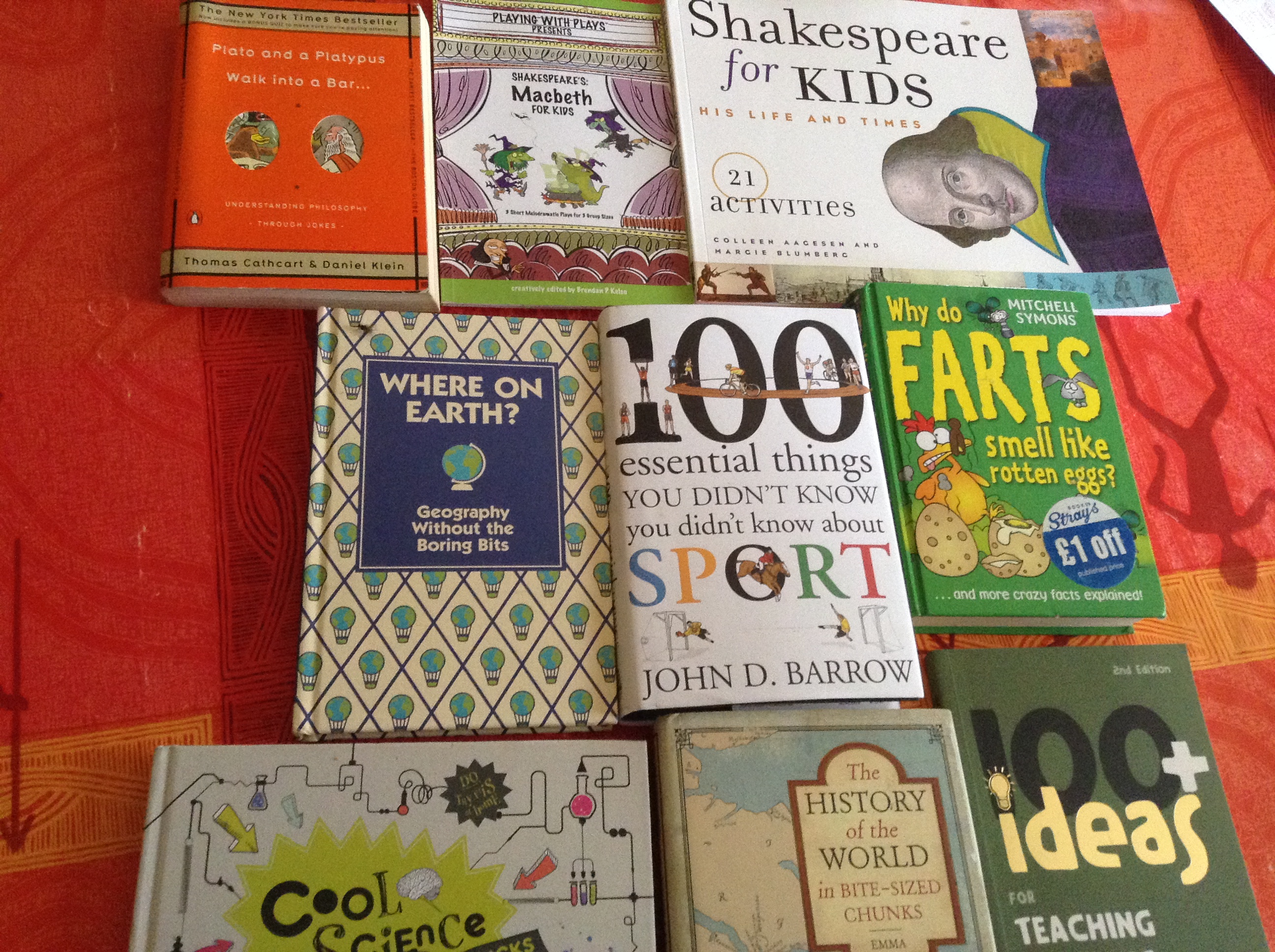
Last year we did some great stuff with Shakepseare and Star Wars, and here is some of the stuff I have planned for next year;

photo

Even more fun is some of the background reading I’ve been doing to prepare this course;


photo (1)


Have you got any more ideas for me?


Posted in Advanced English Programme | 1 Comment