
Harrogate Friday – part 2

Blogger-harrogate-300x300-banner

Michael Hoey : Old approaches, new perspectives: the implications of a corpus linguistic theory for learning the English language. 

An absolutely fantastic plenary, I’ve never heard Michael speak before (that’s the great thing about #IATEFL, us mortals get to call the gods by their first names!) but he was great. An interesting subject, very well-presented, with plenty of anecdotes and humour, and a strong theme.

So good in fact, I suggest you take out some time and watch, or at least listen to, him here while you read the rest of this.

Developing Competences : a framework for teacher professional development with Andrew Nye

Obviously anything on CPD was going to catch my eye and Andrew described and explained the new Cambridge English Teacher framework.

I’ve been a Cambridge English teacher for a few years, and the interview I did for them this morning got me a year’s free membership, so I’ll be renewing again thank you very much! Seriously I have done several  online courses with them, and will be doing their CLIL one as soon as I have time. Details can be found  on their website.

My interview made me a few minutes late for the ELT conversation between Jeremy Harmer and Scott Thornbury.

Although it is probably against conference etiquette I sneaked in (to an enormous auditorium and made a row of people stand up so I could get to a seat!) as there was no way I was ging to miss this one – although I was torn between this and the great Penny Ur who was programmed at the same time to run a workshop on Teaching English for Academic purposes: insights from experience.

The boys, Jeremy and Scott, talked about, amongst other things, the communicative approach, dogme, etc. They had a great repartee and some of the things they said particularly struck home, for example Scott’s comment about accepting correction in the language classroom that he would have resented from his friends outside. I’m sure my husband will recognize that scenario in my journey into the French language!

I also appreciated Scott’s comment about learning a language by using it, not learning a language TO use it.

Anyway, I’ll let you make your own mind up, by watching them here.


Posted in Conferences | Tagged | Leave a comment

Harrogate Friday – part 1

Blogger-harrogate-300x300-banner

Another fantastic day at Harrogate, I started my day (after a fab cooked breakfast at my guesthouse!) with:

How to write an effective IATEFL conference proposal by Madeleine du Vivier

Madeleine is conference programmer so if she doesn’t know what she’s looking for, then nobody does, and indeed she had very clear ideas about what was required.

As I was giving a workshop this afternoon I’d obviously managed to produce an effective proposal once before, but to be quite honest, I wasn’t sure why, and I’d like to do it again, without the complete fluke element this time.

Madeleine explained that some elements were outside our control; IATEFL looks for a balance in the following areas:

First timers-established speakers

EFL topics & concerns (ie mobile learning, writing, etc.)

Speakers from various geographical regions

Speakers from various teaching contexts – YL, business, etc.

Firstly you must decide on what format you would like to present:

a talk – 30 mins

a workshop – 45 mins ( maybe the easiest to start with as hopefully the participants will be doing at least some of the work!)

The Interactive language fair

a forum

a synposium

a panel discussion

There are certain criteria that must be respected, as Madeleine pointed out, if you can’t count to ten, you’d probably not be best suited for the job!

The title is maximum 10 words long, and must describe what is in the box so to speak.

The abstract is 50-60 words long, you must think VERY carefully about this as that is what the participants base their choice on.

The summary is 200-250 words, this is where you describe in as much detail as possible the hows and whys and try to persuade the powers that be to let you in. Do not repeat the abstract in the summary and DO NOT GO OUTSIDE THE WORD LIMITS for any of these.

IATEFL are looking for:

– Clarity – We will look at, participants will do/see/learn… explain context, aim and outcome.

-Don’t be too broad in your subject.

-Don’t aim to low, these are professional teachers, it’s not CELTA bootcamp.

-Say something new.

-Don’t present incomplete research, we’ll wait until you’ve finished, thanks.

-Don’t be too personal, nobody wants to hear about all your experiences UNLESS they can take away something concrete to use in their classes.

– Aim to take theory and show it in a practical application.

– you must not have given the same/similar session at a previous IATEFL event.

Timing details– You should read the proposal information that is given out in June, and submit your proposal by mid September, find out more details about this on the website.

You should here back from IATEFL by mid November, unless they ask you to resubmit, in which case you’ll know in January.

Finally, don’t forget you must be a member of IATEFL to submit a proposal, but that’s no hardship, is it?!


Posted in Conferences | Leave a comment

Harrogate Thursday…the end


Finally I here you cry!

After a well-deserved coffee and slice of caramel shortbread I popped into another couple of sessions:

Teachers change learners, learners change teachers: changing methodologies with Jane Spiro

Jane was a breath of enthuasiasm for all things TEFL, at a moment in the day when I was flagging. A simple, well-presented experience where we were asked to think about some crucial questions and situate ourselves on a scale. Teachers were encouraged to share experiences  on the following:

Who chooses how and what to learn? The teacher or the students?

Is my job to improve their English or improve their lives? – Where are the boundaries?

Am I really the teacher I think I am? -Does recording a class change your beliefs?

Am I afraid of silence in a classroom? (I teach at secondary school, so it’s more a dream than a problem!)

What is discipline? What is fair discipline?

What makes us change as a teacher? Students? Other teachers? something you read? Self-realization?

Jane finished with this quote; “The TESOL profession now connects the word with the world”.

The Earlier the better? Empirical results on primary EFL instruction by Eva Wilden

Eva presented results from the early stages of what will become a longtitudal study on the effect of early EFL in Germany. So far results have shown improvements in L1 reading comprehension amongst German speakers, but not amongst speakers of other languages.

This session also gave me a chance to catch up with Fiona Copland who proposed the motion in the morning’s debate. I discovered that in fact she has taught primary English for years.

So harrogate Thursday draws to the end, just as Harrogate Friday is about to begin. I’ll probably fit in less sessions today, however I have my chat with Cambridge this morning to look forward to, and my own workshop this afternoon (1:35 in Studley if you are interested!)


Posted in Uncategorized | Leave a comment

Harrogate Thursday continues…

Blogger-harrogate-300x300-banner

Bill Murphy hated his groundhog day, However I love mine, in fact I’m lucky because I will wake up tomorrow and get another day of #IATEFL. Our days do differ in one important way of course, nothing has been the same in my day, and I’ve learnt so much.

This afternoon I attended the following sessions:

Open Space event with Adrian Underhill

The idea behind this event fascinated me, billed as “a conference within a conference”, the idea is simple – attendees write a title/question/problem on a post-it, these are then grouped into common themes, we vote for our top ten or so favourites, then break off into different groups per theme to discuss/solve etc.

The only problem was that I did not obey the only rule of the session, I know, there was only one and I couldn’t even manage that, it was  the law of two feet -If you are not contributing or getting something then take a walk … to another group.

Actually, I did contribute, although the subject was not really what I’d hoped, or expected. I think our group was too eclectic and we all had different expectations of this event.

I would still like to attend another open space, however I think its success depends a lot on group dynamics, and maybe on choosing the right topic.

Motivating teenagers by involving them in assessment with Deborah Bullock

Perhaps one of my favourite sessions, I’m fascinated by the new theory that I’ve been finding out about, and conferences are there to pick up that, however you can’t beat a good old workshop when you walk away with a lesson for Monday and a way of improving your teaching in the long term.

I’m interested in self-assessment. It’s not easy in my context, a secondary school where frequent testing is not only expected, but the results are directly responsible for the pupils passing into the next year or redoing this one. However I agree with Deborah when she pointed out the benefits which include motivation, reflection, increased ownership, as well as a useful life skill, since self-assessment is required as much in the workplace as the classroom, if not more.

After discussing the disadvantages ( lack of accuracy, taking up teacher time, etc.) Deborah gave us some practical tips of how to put into place self assessment in our classrooms :

-make it meaningful

-make the criteria clear

– use functional “I can do” skills, along the lines of the European framework.

We looked at how to prepare a task form to scaffold the pupils in an oral presentation task, and then looked at how to negotiate assessment criteria with the students to produce a task assessment form. This should include:

-title

-criteria

-feedback, including “I could make it better by…”

-space for comments by learner and teacher

– overall grade.

Deborah managed to fit in a lot of useful information in a short time, whilst simultaneously encouraging group work and pair discussions.

I saw another couple of sessions that I’ll tell you about another day, I’ve a little last minute preparation to take care of for my own session tomorrow first.


Posted in Conferences | Tagged | Leave a comment

A Harrogate Thursday

Blogger-harrogate-300x300-banner


Get all the info here.

Oh my, where to start, seven presentations in ten hours, several cups of coffee, some lovely people and a suitcase full of freebies, my brain is buzzing, or melting I’m not sure which!

What have I learnt today?

How to get published in a refereed journal with Graham Hall

A very interesting session, Graham gave plenty of concrete hints and ideas, including:

1. Write with a specific journal in mind, they all have different requirements relating to wordcount, style (theory vs practical for example), so look at a few copies and ask for their author guidelines first.

2. Start small, write up something small but specific from an action research project before trying to publish your whole thesis.

3. Don’t be too local or specific – make sure it will interest a broad audience.

4. Be sure your work is clearly written, is internally consistent and accessible – i.e. understandable and not full of obscure anacronyms.

5. Illustrate awareness of other research in the same field but don’t overdo the references, for example 15 is pleanty for ELT Journal.

He explained the editing process and the time delay of up to  60 days from receiving work, and his final piece of advice was upbeat and optimistic – kind of!

6. Don’t give up! Nobody is ever published straight off first time round, expect a request for revision at the very, very best!

The efficiency of inefficiency: an ecological perspective on curriculum by Kathleen Graves

This was a very well presented session, in which Kathleen talked about the place of relationships, students’ needs, time and a long-term view in the classroom. I couldn’t begin to do justice to all her ideas but I’m sure they’ll soon be available here.

Investigating praise and giving feedback by Lesley Keast

This was a presentation of Lesley’s dissertation for her M.A. that she did through Sheffield Hallam (where I’m doing mine) so I was especially interested by the postive things she had to say about the team there.

Her paper was detailed and very organised, and gave me an idea of the hard work I will have to put in!

Then I attended the debate – this house believes that primary ELT does more harm than good.

Fiona Copland did a fine job in proposing the motion, citing a lack of coherent evidence, the problems finding trained teachers for this level and the need to concentrate on literacy and Maths at this age.

Janet Enver opposed the motion with the comment “the deed is done”, primary ELT is an intergral part of the school curriculum in many countries and we should be working towards its successful development.

Audience participation brought up many issues dear to my heart, class numbers – for example I heard about classes of up to 70 children in some countries, and thought about my negotiating for class sizes of maximum 20. There were also teachers from Switzerland talking aabout ELT in multi-lingual countries, where other national languaes are already obligatory at primary level.

This was a fascinating debate, and I must admit Fiona nearly won me over, my own experience has shown that after a couple of years at secondary school, those pupils who learnt English in primary do not necessarily have better results than those who started later. This I feel is because, due to the haphazard nature of primary English, one year, or two, or none, or maybe German instead, we always have to “start from scratch” in secondary school.

I say “nearly” because there is one fact that pulls me back to supporting primary ELT, and for me it’s the most important – THE KIDS LOVE IT! I’ve shouted it because it’s very important for me! If they love English, they’ll be fine, they’ll learn.

All this was only the morning, it’s been such an information-packed day. I’m just poppping out for dinner, and then I’ll be back with this afternoon’s highlights in a bit.

Bon appetit!


Posted in Conferences | Tagged | 3 Comments

6 ways to recap the lesson

One of my weaknesses is the lack of plenary in many of my classes. I’m so busy teaching and getting lots of things done that I don’t always make time to step back and think.

Here are some ways to help your students reflect on and review their learning before moving on.

20140330-145538.jpg

Posted in Fab ideas, fast finishers | Leave a comment

5 more fast finisher lists

20140330-145125.jpg

Posted in fast finishers | Leave a comment

Looking forward to Harrogate

Blogger-harrogate-300x300-banner

All the information is here.

This is a BIG week, my birthday today, off to Harrogate on Wednesday, and rounding off the week by participating in the Paris marathon on my way home!

Yes, I’d prefer to be on my way to Harrogate at this very moment, but our head has decided that my classes of 9-17 year olds might not sit there quietly, waiting for my return, and my colleagues have other things to do than substitute a week of English classes – like teach their own subjects, in French!

So what am I looking forward to most about this week, apart from that post-marathon bath?

1. Meeting like-minded teachers

Teaching in a secondary school I sometimes feel a bit out on a limb, although I teach English as a foreign language we have other constraints such as frequent testing, reports etc.  I rely a lot on my PLN so I’m looking forward to meeting in person the people I follow on twitter and those who write the blogs I follow, like reflectivelearningreflectiveteaching.

2. Learning lots of things

I enjoy conferences and workshops for the way they make my brain fizz!

There are so many wonderful workshops, plenary sessions, how to talks… I’m double booked all conference, sometimes I’ve even got four possibilities at the same time, I can’t decide what to see,  but I will have to I suppose.

One thing I have noticed about these sort of events is that they get me thinking about my teaching, often the ideas I come home with  come from these moments of reflection, and not necessarily the talks I’ve been to (although they are great too!).

3. The extra stuff

I’m also looking forward to checking out new material at the exhibition and meeting the folk from Cambridge English teacher.

4. A change is as good as a break

Much as I love my job, my life etc. it’ll be nice to give the 5:30 am dogwalk a miss, and stock up on branston pickle and crumpets! A few days away from home will give me chance to catch up on some reading, maybe even watch a film or episode or two.

All in all, it’s going to be a marathon week, see you there! – You can recognise me by my footwear:

newdocs

See you there!


Posted in Conferences | 4 Comments

7 lists to get your fast finishers thinking

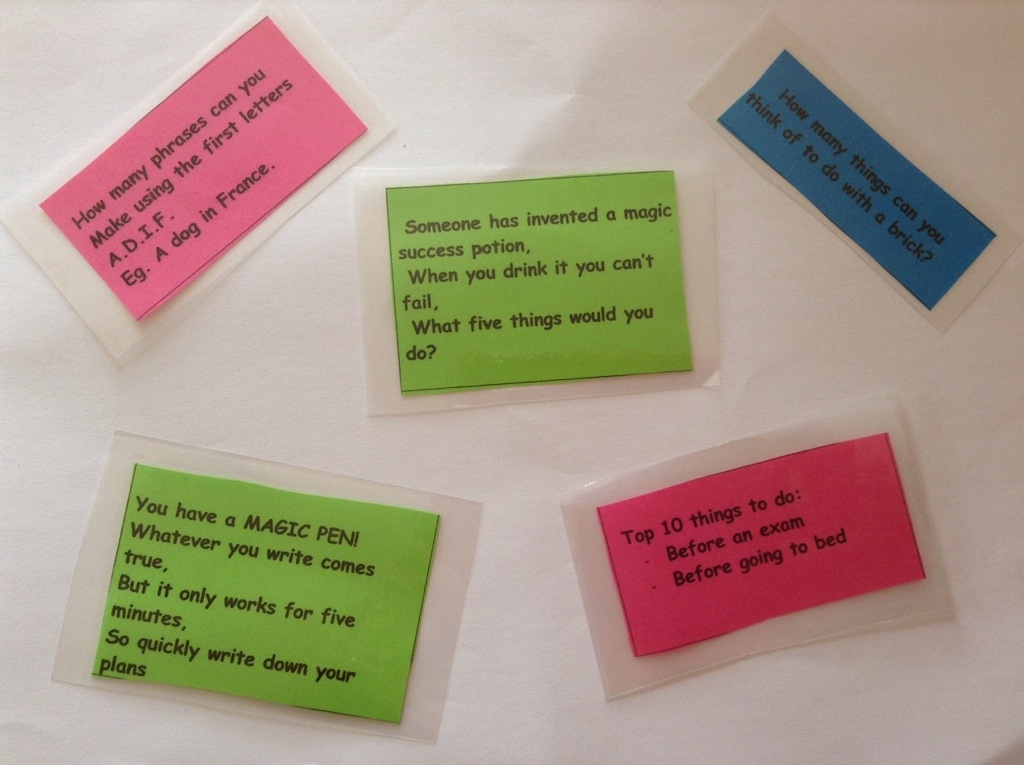
People love lists and students are no exceptions, so here are some examples of lists your students can make while they’ve got a free minute or so in class.

I often note one on the board at the beginning of the class and then see what they have come up with at the end of the lesson.

20140330-144835.jpg

Posted in fast finishers | Leave a comment

6 reasons to film your lesson

This week I found myself standing in for a colleague by taking both our classes for two hours. “Great” I thought, enough time to do something meaty.

To motivate the classes for double English I promised a “no pen lesson” (something we do every so often, great for kids and teachers alike).

The lesson plan went along the lines of – chose a lexical theme, plan and act a scene using these words and the rest of the class will guess the topic.

The subtext was “get out the camera”.

The lesson went well and the resulting film will be premiered next week before appearing on my youtube account. In the mean time it got me thinking about why I enjoy filming in class:

1. The Students are the Star– unless you’re actually going to film yourself teaching, any lesson that involves filming is bound to end up being pretty student-orientated.

2. Speaking and more Speaking – any filming is going to involve oral participation, a big tick in all my boxes.

3. Keep a record – It’s easy to give feedback for oral work but hard for the students to take it in, because they don’t have an acurate idea of wwhat they actually said, unless you show them.

4. Look back in wonder – I like filming various projects throughout the year, not only can students see how they’ve progressed, but it also makes a fun last lesson when we watch all the year’s films, where we see how dress sense and hairstyles have changed too – believe me nine months is a long time in teen fashion!

5. Helps discipline – although pupils can be a bit excited to start with, filming them does tend to curb any behaviour problems, they never now who you’ll show the film to!

6. It’s easy – apart from the fact any activity seems to have a more serious objective if we are filming it, with so many devices available you can film with your phone (or theirs – get them to interview each other and film it.), tablet, etc.

Obviously you must check you have their (parents’) permission before you publish anything, although you can get round this by using masks and puppets.

If you are interested in having a look at some of the things we’ve done so far – click here.


Posted in Fab ideas, geekicity | Leave a comment