Downhill from now on and a ridiculously simple “back to class” activity

So it’s the Sunday before school starts again and I’m tackling my marking pile, but I don’t care because I had a great holiday, took a trip with my family and bought a new coffee machine – can life get any better?

If you aren’t full of the joys of spring you might like to read Edutopia’s post on 10 tips to avoid teacher burnout. If you don’t know Edutopia then I suggest you hop over there straight away, not only is it packed full of great posts, but it’s financed by George Lucas, so it is obviously from the good side of the force.

I particularly agree with the following tips :

-stay in good health, running not only keeps me fit but sane too.

– learn something new, a rut is the worst place for a teacher to be, I was thinking of looking at coding with some help from codecademy.

-stay positive, and be a positive voice in the staffroom. if, like me, your staffroom is full of moodhoovers then it’s especially important to keep up those positive comments, you will find that like-minded teachers who were just waiting for a chance to bloom at school will dash over to your side of the room and soon your few breaks will be full of uplifting laughter, and no, that doesn’t mean you have to only think positive things about EVERY pupil, parent and colleague, just don’t whine on about the bad things!

Now for the ridiculously simple first lesson activity; After years of planning flashing hoop jumping lessons for the first day or week back, which were forever ruined by pupils just chatting amongst themselves about what they got up to in the holidays, we do just that.

I put them in groups of four or so and they chat about their holidays, I encourage them to ask each other for vocabulary and then as soon as I feel them slipping into L1 I take one from each group and do the same thing with the newly formed groups.

This way when a couple of volunteers (and the naughty boy at the back!) tell the whole class about their fun-filled week they’ve already practiced it twice and aren’t as self-concious. I sometimes get them to add another couple of new “facts” which may or may nnot be true, and check who’s paying attention by seeing if anyone from their original group calls them out with a “that’s not what you told us!”

Whatever you’re planning for tomorrow make sure you get some “me” time today, and the secret to every great teaching day… a good night’s sleep!


Posted in Fab ideas, survival tips | Leave a comment

The classroom is not the matrix

I read all these articles and posts about how the classroom is not an authentic place and I can’t help thinking that my students, as secondary school pupils spend about seven hours a day in a classroom, you can’t get much more real than that, can you?

Even for adults at evening classes or taking lessons within their company, surely their English class is a real part of their day or week.

Why do we suggest these moments lack authenticity? If you go jogging once a week, it is still an authentic moment, so why do we act as if English lessons occur within the Matrix and need something extra to make them “real”?

Posted in teaching journal | Tagged | 1 Comment

49 ways to Teach like a Champion – a book review

I’m a sucker for motivational teaching books, such as the brilliant Teaching Like a Champion by Doug Lemov and Norman Atkins. This may have something to do with the not-so motivational atmosphere in our staffroom. After spending break-time avoiding the mood hoovers it’s nice to read something in the evening that makes me go “YESS!!!”

The book is split into 49 simple but effective techniques, here are some of my favourites:

1. No Opt Out – “dunno” is not an acceptable answer, get the pupil to find the correct answer, get another pupil to tell him, you tell him, tattoo on your forehead, whatever it takes, but don’t leave it at “dunno”, get the pupil to give you the correct answer themselves, even if they’re repeating what their friend said. I also get them to do it again in our end of lesson review.

6. Begin with the end – start by planning the long-term objectives, then the assessment, then the lesson, then the activities.

12. Find the hook – what is the unique selling point of your lesson? How will you hook the students’ attention the minute they walk into class?

15. Circulate – as a teacher aim to break into the back half of the classroom territory within the first 10 minutes of class, let them know you can and will be everywhere.

20. Exit ticket – make each pupil answer a question, recall a new lexical item, explain something, before they can leave at the end of the class.

25. Wait time – give pupils enough time to answer, let them know how much time they’ve got, if they need more tell them you will ask someone else but will be coming back to them later.

29. Do it now – have a short activity on the board waiting for them when they arrive in class, so they always have something to be doing.

37. What to do – tell pupils what they should be doing, not what you don’t want them to do, be specific.

40. Sweat the details – if they’re not lining up correctly, wasting time handing out worksheets, not putting work away in the right place, do it again and again and again, time wasted in the first few lessons is saved 100-fold during the rest of the year.

There are loads of other great ideas, with simple explanations and examples. The book also has a DVD where you can see these techniques in practce in the classroom – unfortunately the kindle version doesn’t.

I would recommend it to newbies and oldies alike!


Posted in Reviews, survival tips | Tagged , | 2 Comments

What is the point of this?

Just last week I was showing off to my maths and history colleagues about how I have I have never, ever been asked this question in class, when yesterday, you’ve guessed it…

You may remember the oral fluency lesson I did with one of my classes yesterday (see here if you’ve not been paying attention!).

20140411-161908.jpg


As I mentioned in my previous post, the majority of the class really enjoyed the lesson. One student however asked me the dreaded question:

“What is the point of doing this?”

When I asked what he thought the reason for the activity was, he  replied with

“You’re the teacher, you tell me”

So much for encouraging autonomous learning!

I explained to him that this was an oral fluency activity, which would be assessed according to the criteria that they had agreed upon themselves in the previous lesson.

He wasn’t really convinced and hung out at the edge of his group, making the odd effort whenever I was in the vicinity.

After finishing the activity and wiping the marshmallow off the tables the students completed their assessment sheets, assessing their own performances and then asking their team mates to assess them as well.

I asked the class how they felt the lesson had gone, all (except My Grumpy pants!) agreed it was a fab lesson, but what I found interesting was that only two or three (out of seventeen) actually thought they had learnt anything. A couple, including you know who, thought lessons should have more structure.

This got me thinking about Thornbury’s dogme, Jeremy Harmer asked an interesting question at their conversation at the recent IATEFL conference in Harrogate;

“Why do you think what the students come up with in class would be better than what the teacher brings in?”

I think a certain student would probably say;

“Why do you think anything you bring in will be better than the textbook?”

I’m not sure how he’d survive a dogme class, but it does bring home how many different kinds of learner there are, and perhaps, while we are busy changing the world of teaching (or is that learning?!) we should remember that there are actually some students who would prefer a nice and cosy P-P-P lesson.


Posted in teaching journal | Leave a comment

What to do with spaghetti and marshmallows in class

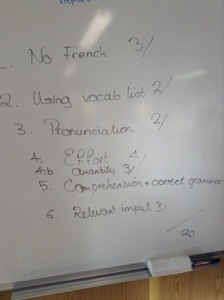
Following an #IATEFL session by Deborah Bullock on self-assessment with teens, I decided to do something similar with our regular “no French Friday”.

Earlier in the week the class decided on marking criteria for this speaking lesson;

20140411-161526.jpg

After writing up and giving out the marksheets so the pupils had to assess themselves and the other members of their group, we set to work.

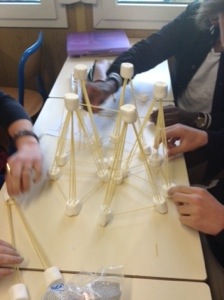
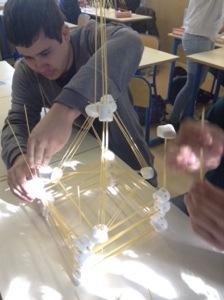
They had 40 minutes to build the tallest, freestanding structure possible using a packet of spaghetti and a packet of marshmallows.

The majority of the class really enjoyed the lesson.

If you try it remember to take in something to wipe down the tables afterwards – it can get quite sticky!

20140411-161818.jpg

20140411-161908.jpg

Posted in Fab ideas, Friday classes | 3 Comments

Fun & easy vocab revision

Easy peasy and great fun! “Pick” a volunteer (once the class sees what the idea is they are usually begging to come forward!) and get them to stand with their back to the board.

Write a word on the board that the pupils have learnt recently, or something to present the theme of today’s lesson.

The rest of the class must then explain the word and the volunteer must guess what is written “behind his back”.

To start with, the rest of the class put up their hands politely, but they’re soon yelling out their hints, which can make it even harder for our helpful volunteer!

I was amazed by how well even low level groups could define their vocabulary. They also enjoyed having the volunteer write the word behind my back!

Posted in Fab ideas | Leave a comment

Differentiation – What to do with fast finishers and slow starters: My harrogate workshop

Blogger-harrogate-300x300-banner

This is the write up of my session at Harrogate. It went very well, although I’d originally suggested a maximum of 20 participants, we ended up shutting the door at 35; mainly because there were no more chairs in the room!

It’s very, very simple. Anyone who has taught a group knows that students always have different levels and speeds for various activities, so the problem is this, what to do with the fast finishers while the others are still completing an exercise?

An added complication is that with certain classes, for example twenty-odd teens on a Friday afternoon, the devil really can make work so we want to avoid idle hands.

Solutions can include:

-Stopping the class and start correcting – but then the slower students never finish anything, a very frustrating feeling.

– Letting the faster ones wait – see above for potential danger!

– Letting the faster ones start the next exercise – you’re only putting off the problem

-Giving out extra worksheets – this equals extra work for the teacher too!

After discussing these we had a very lively session trying out some of the following ideas, they can be used either in relation to a text the class has just studied, or in relation to the lesson as a whole. They would also work at the end of a sequence of lessons or the end of a chapter for example.

I have them written on small cards and students pick them from a box at the front of the class when they have a free moment, or sometimes I write up a “menu” including a suitable selection, and all the students do whichever take their fancy after a reading comprehension, or for a revision lesson.  I also try and take into account different learning styles, and include things that avoid vast chunks of writing to help my dyslexic students.

FLAME TEST – rewrite the text/explain today’s lesson so a young child understands it.

NAUGHTY ELEPHANTS SQUIRT WATER – create a mnemonic aid to remember new/key words from today’s lesson. (Give aid to rest of class, they guess key word.)

TWEET IT – write a tweet (140 characters max.) to resume the text/what you’ve learnt today.

PICTURE THAT – draw something to represent key ideas from text/lesson (show partner, they guess).

ANGRAMS & Co. – Write anagrams, synonyms & opposites of new vocabulary, (class guess orginal word.)

THAT REMINDS ME OF…- Think of a personal anecdote related to the text and share it with the class.

SELL IT! – Write a slogan & draw a logo to represent what you have learnt in class/from text.

SPRINT IT! – How many words can you write in three minutes based on text/lesson? 1 point per word, minus 2 points per error.

SAY IT IN 20 – Resume text/lesson in exactly 20 words.

ADJECTIVE RECALL – what adjectives can you find in the text/did we use in today’s class? What other things can these adjectives describe? ( Give list of other things to partner, they must find adjective.)

STAIRWAY WORDS – start with a word from today’s lesson, then write another word vertically down starting with last letter, then across using that word’s last letter etc. (Can also be class game with two teams in lines at the board, first student writes a word & then hands pen to person behind and moves to back of the line.)

HAND IT TO ME – Decide on the 5 key words to resume lesson/text, each one represents a finger.

HAIKU It – write a haiku ( three line poem, first line 5 syllables, second seven, third five) to resume text/lesson.

SMELLS LIKE – write all the smells evoked by the text.

DEAR DIARY – write a diary entry from the perspective of a person from the text (or from an animal or inanimate object, e.g.  “I am John’s car…”).

ANIMALIZE HIM – Choose an animal to represent the people in the text, explain why you chose that particular animal.


Bibliography


All good ideas have been stolen from somewhere, although I can’t remember where each one came from, however  I have found some great sources amongst books designed for primary and secondary teachers in Britain, a refreshing step away from the world of TEFL. These include :

Beadle, P. (2013) Plenary, Wales. Independent Thinking Press

Beadle, P. (2010) How to teach. Crown House Publishing

Gilbert, I.  (2002) Essential Motivation in the Classroom, Routledge.

Gilbert,I. (2007) The Little book of Thunks, Crown House Publishing

Smith, J. (2010) The Lazy teacher’s handbook, Crown House Publishing.

Any questions? Send me a message!


Posted in Conferences, fast finishers | Tagged | 3 Comments

Something different to do with animals

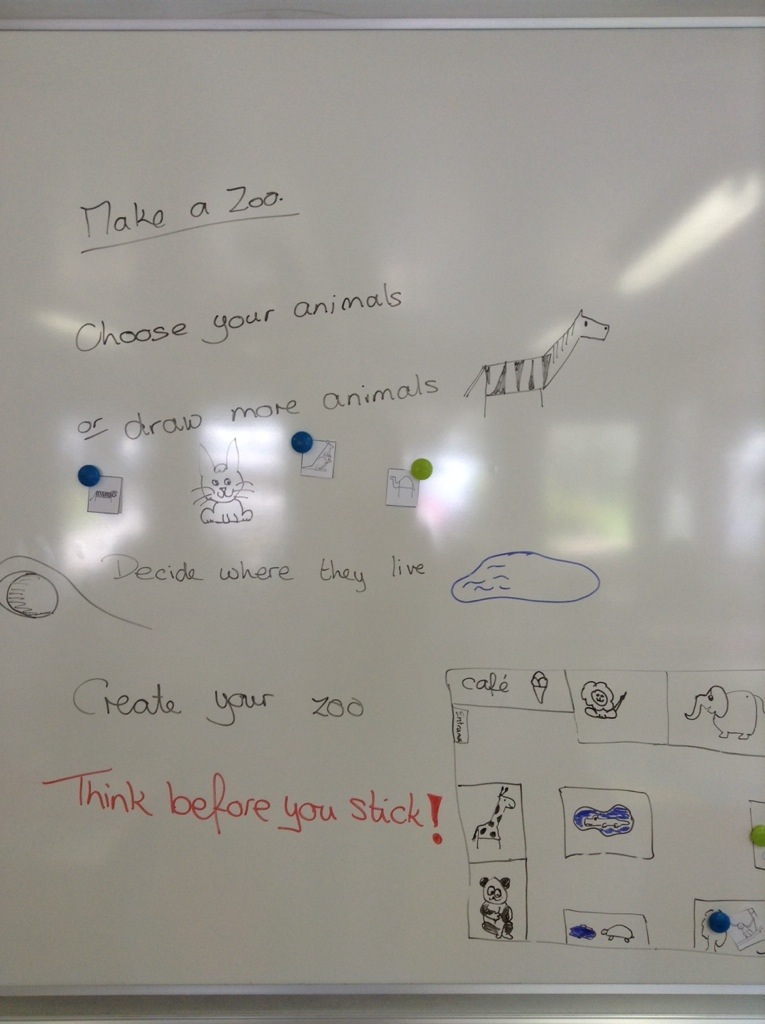
When we were tired of miming them, guessing what they are from the noise they make (there are some good apps for this, and for household objects, musical instruments, etc.) we decided to do something different :


20140407-143610.jpg

Not only is it a great excuse for some colouring and cutting, but also we need to think about things like :

Where should the sharks go?

Is it a good idea to put the rabbits next to the wolves?

Where shall we put the ice cream shop?

20140407-144002.jpg


Here’s the finished result:


20140407-144025.jpg


Not only something different to do with animals, this activity also promotes group work, and recycling language such as:

“The rabbit doesn’t like the wolf”

“Put the shop next to/on the left of the door”

Posted in Fab ideas | Tagged | Leave a comment

Four ways to make revision buzz!

Often students find revision tedious, many don’t know how to revise effectively, and for some of my pupils it’s more a case of “vision” than “RE-vision”!
Here are some ways to make revision fun, I especially enjoy the one where they write down and complete “I’m sure I’ll forget…” By writing it down they’re sure to remember it!

20140330-145926.jpg

Posted in Fab ideas | Leave a comment

Harrogate Friday – part 3

Blogger-harrogate-300x300-banner

My first session of the afternoon was the utterly amazing Rachael Harris with Differentiation : What to do with Fast Finishers and Slow Starters. I was somewhat obliged to attend, what with it being my workshop and all! it merits its own post, and a little reflection, so I’ll give you all the details later.

On a post-peak high I wasn’t sure what to attend next and wandered into what turned out to be one of those conference nuggets, you know what I mean, a session you don’t really expect to get anything from (or in my case that you haven’t read up on before), which turns out to be great.

Exploiting video in the language classroom with David Bradshaw was an extremely well-presented, informative, and entertaining session. David was generous with his ideas and sources, and I have the feeling his classroom would be a fun place to be, check out his blog here. I’ve got some great ideas for classes next week thanks to him, not to mention the fantastic word “screenagers” which I hadn’t picked up on before.

As Cambridge YL exam coordinator at our school I was bound to attend the session by Angela Wright – Young learners: moving with the times. Interesting and clear, I must remember to check out the Monkey puzzles world tour app with my pupils.

I saved the last few drops of TEFL energy that I possessed for my last session of the conference:

Bringing Critical Thinking into the Young Learner/Teen classroom with Vanessa Esteves

and I was very glad that I had. This was an information packed session, that could have easily gone on for another hour. Vanessa’s enthusiasm was catching, her suggested apps and websites were useful, and as I teach both YL and teens I was in relevance heaven. I agree with her on the importance of critical thinking, and will be using her big questions ” How did you know that was the answer?” “What makes you say that?” in class as often as I can get away with.

I need to reflect a little more on all the things I’ve learnt over the last few days, but one thing I’m sure of is… I’ll be back next year!


Posted in Conferences | Leave a comment