Oral exams

Every year I ask myself the same questions about how best to evaluate the oral skills of my students, for me this is the most useful (and used) skill in a foreign language, but the most challenging to evaluate.

Obviously I assess continually throughout the year but our school has end of term exams with an oral section, these exam results count for a third of their term grade point average, which determines whether they pass into the next school year or not, so it’s important to get it right.

Another factor in oral exams is student stress, it sometimes seems that the hardest working students get the most stressed out with these exams!

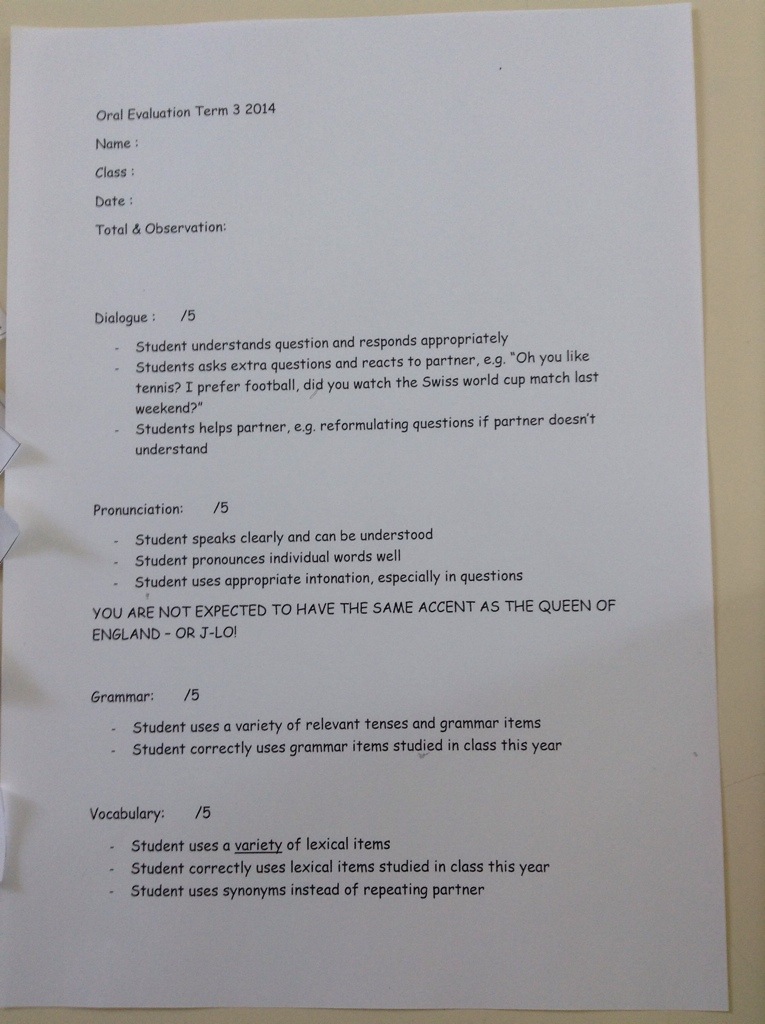
This year I asked them to come in pairs, which alleviated some of the stress, I had written out a load of questions related to the year’s work, “what are you like?”, “What can you remember about the Mayflower?” …

20140619-061929-22769459.jpg

The students took it in turn asking questions, however I really encouraged the creation of a conversation, as opposed to some kind of speed interrogation, points were given for asking extra questions and helping your partner if they got stuck.

20140619-062110-22870314.jpg

They seemed to find it a more enjoyable experience, it gave me more time to take notes than when I question the students directly, and I also found it fun, I even joined in on a few interesting topics myself!

Posted in teaching journal | Leave a comment

A Quick , kind and fab idea for the end of term.

A friend saw one of these in her gym so I borrowed the idea and put a couple on the door for students to take as they walked out if their oral exam this week… I love it!

20140619-061101-22261902.jpg

Posted in Fab ideas | Leave a comment

5 minute filler

Not to be done when you want calm and quiet!

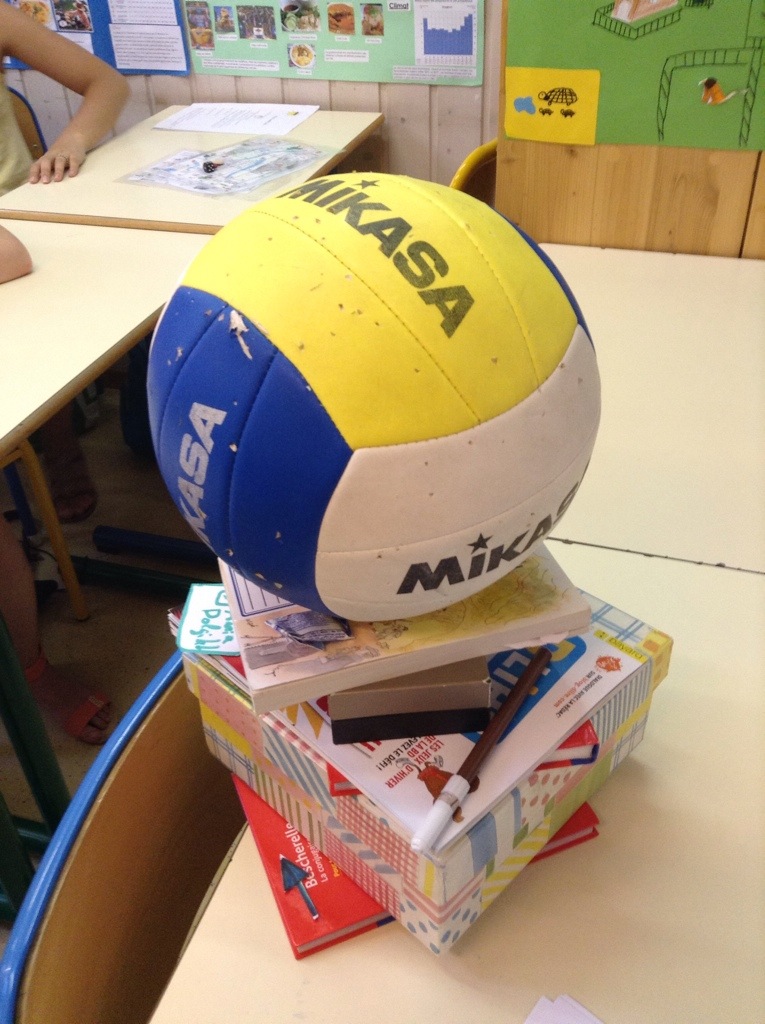
Bring me something beginning with…

20140616-155749-57469291.jpg

Posted in Fab ideas, fast finishers | Leave a comment

What to do about Invisible Students

Do you have them too? Those students who are so discrete, quiet, shy or just self contained (and well-behaved!) that they simply pass completely under radar.

Every year I have a few, often they have a level way above that of the rest of the class, so they don’t want to show off, or take class/teacher time away from the others. They work well in groups, I know they’ve got it right so they aren’t on the  priority check list. They never complain, ask very few questions.

Sometimes I get to report time and think “OM, what do I actually know about this kid?”

Here are some ideas to avoid this dilemma:

– Every week I look through the register and make a quick mental calculation, anyone whose participation is under par gets “picked on” (in the nicest way of course!) the following week.

– I differentiate homework and oral presentations so excellent students still have to work, and they enjoy being pushed more too.

– I change groups for oral and project work regularly, grouping by friendship groups, alphabetic order, or random dice throwing sometimes to try and get everyone working with each other at some point of the year.

– I try to ask as many BIG questions as possible, to encourage critical thinking in class. To be sure this gets done I write at least three questions on every lesson plan and write them on the board as we come to them – they are great to come back to in order to check learning at the end of the lesson.

What about you? What do you do? All ideas are welcome!


Posted in classroom management tips, Fab ideas, teaching journal | Tagged , | Leave a comment

Making Shakespeare fun

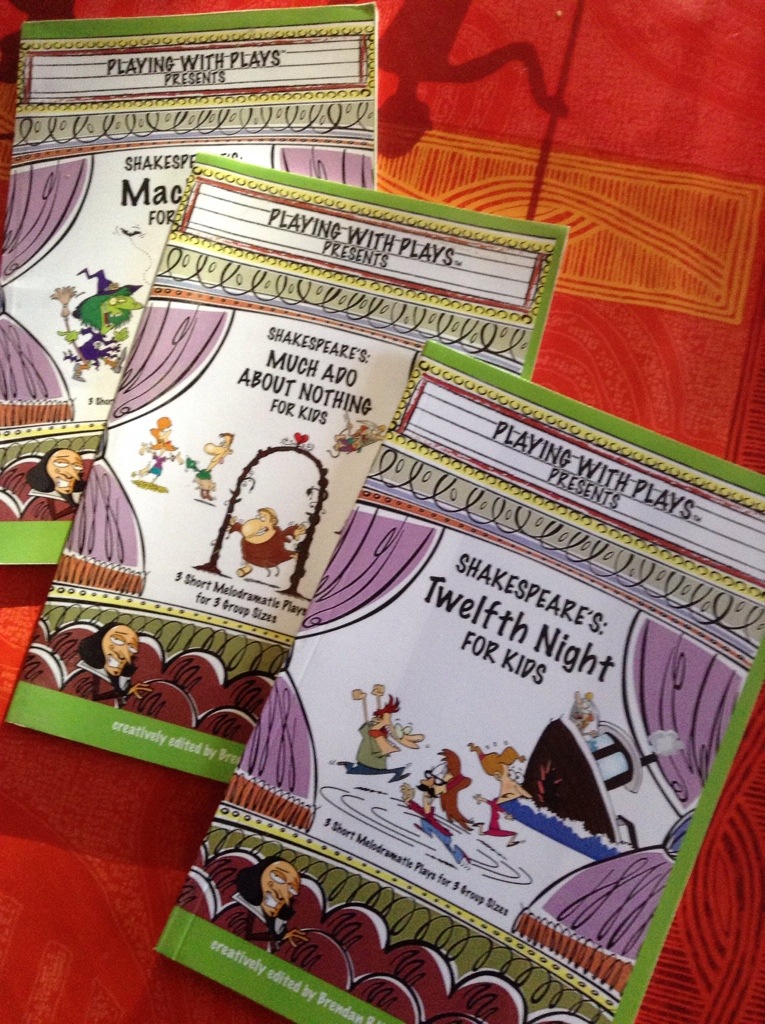
Let me make it clear from the start that this is a blatant advert for the “playing with plays” series that I stumbled across on twitter.


20140607-072055-26455165.jpg


I’ll set the scene, I teach in a French speaking secondary school in Switzerland and give an extra class for English speakers. These kids were often born here, have never been in English speaking education but obviously have a very good level thanks to imput from family, friends, etc. It’s interesting to see that, although it might be their maternal language, English is not necessarily their first language.

The objective of this class is to improve spelling, increase vocabulary, and learn more than they would in a class for non-native speakers.
The fact the class is at the end of the day and is not taken into account in the end of term results (needed to pass into the next class) means that it’s important and challenging to keep the kids motivated. However this also means no traditional testing, and especially, that I can do more or less what I want.

For me, it’s pretty much a dream class, freedom in choice of materials (I usually make my own as there’s very little that suits) and a group of kids that only come to class because they want to be there.

Despite all that, you can imagine their reaction when I told them that this term we would be studying Shakespeare!

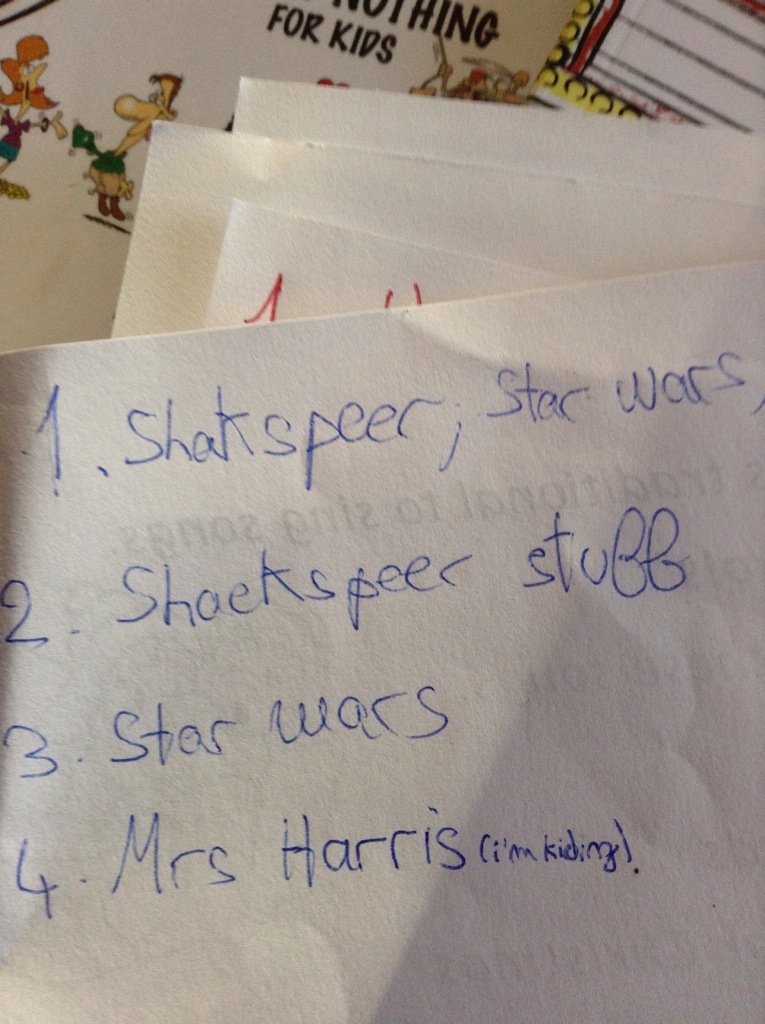
After warming them to the idea using the insult generator to fling some Shakepearean insults around the classroom, we studied Shakespeare’s language using the equally wonderful William Shakespeare’s Star Wars, which enabled me to indulge in my Star Wars obsession in class (again!)

Although they enjoyed all of that they were still a little reticent when I said they would be performing a play in class. I chose “Hamlet” as I felt it was the best known (and would get more kudos with the parents!!). When I produced the book they all flinched, a few minutes later they were in heaven!

The plays took longer than ten minutes to perform, in fact we spent a couple of lessons on them. That also included time to discuss plot development and  for costume (paper crown, ruler for sword…!) changes.

When we finished “Hamlet” they begged for more, so as a special treat we did “Much ado about nothing” at the end of term.

At the end of the school year I always ask for a feedback sheet which includes “what I learnt”, “what I liked” and “what I”d change”. All the students remembered the Shakespeare work…

20140607-072056-26456252.jpg


One of my best teaching moments this year was overhearing an 11 year old explaining to his mum about how Hamlet felt having to decide to kill Claudius or not.


Posted in Fab ideas, Reviews, Uncategorized | Tagged | 1 Comment

How to deal with a long reading comprehension

With my 6emes (many of whom began learning English in September) we have recently started looking at long, scary texts.

When the pupils first see the texts they are… well, scared.

Before we look at the questions I get the pupils to draw a cartoon strip of events, this means they can check their understanding before even looking at the exercises.

We also get to laugh at each others drawing skills!

20140523-110739-40059394.jpg

Posted in Fab ideas | 1 Comment

7 Reasons why your students should take an EFL exam

It’s been a busy couple of weeks here.

Firstly we had our lovely Cambridge examiners team in to do the Cambridge Young Learners tests with some of our pupils.

Then on Monday the wonderful Silvie came to test others for the Trinity GESE exams.

For most of our pupils these exams are optional (Primary are automatically registered for Cambridge, a long story that I’ll tell another day!).

So how do I persuade them to take these exams?


Well, actually it doesn’t take much persuading, but here’s some reasons I give students and their parents:

1. Motivation – there’s nothing more motivating than trying hard and succeeding, or in fact just trying hard.

2. CEFR level – These tests all validate the European framework level that our pupils are working for, useful for summer schools or if they move on.

3. They encourage oral fluency – something we never have enough of.

4. Exam practice – they are the first “big” exams many of our pupils take, and especially having an external examiner makes them a little scarier and more real, and that’s not a bad thing in my opinion.

5. They give an objective to class learning.

6. Everyone loves a shiny diploma! – and receiving it at the end of year reward ceremony.

7. The first step on the CPD path – personally this is the most important reason, but then it would be wouldn’t it? After all, it’s the reason I’m writing this ( and maybe that you’re reading it?!) These exams are not part of the school programme, they are extras, that pupils do to improve and test their worth, of their own initiative (with maybe a little nudge from mum and dad?). I see them as their first step into a world of continuing personal development, where they will be learning and trying to improve for the rest of their lives – and that’s just great!


Posted in teaching journal | Tagged , , | Leave a comment

Revising vocabulary -a speaking activity

I often struggle to find new and interesting ways to revise vocabulary, so I was pleased when this activity went well in class today.

After having learnt some beach vocabulary in the previous class, today I showed the class the picture below.

We studied it and talked about everything we could see, as well as recycling some prepositions to place things.

Then I hid the image and gave them a sheet of paper. In pairs they had to reconstitute the image together.

They enjoyed the challenge and hardly realized it was in fact a vocabulary revision exercise. I’ll be using this again with other word groups and pictures.

20140507-113145.jpg

Posted in Fab ideas | Leave a comment

Field trips for the EFL classroom

Do you ever take your class out?

It’s not always easy or even possible, but if you can manage it then it’s a great experience for both the students and yourself.

1. A change is as good as a break – a trip out is a literal breath of fresh air.

2. Real communication -whether it’s organising the trip in class or actually on the day, not to mention the write-up afterwards.

3. It’s CLIL in action – a chance to see and learn something new in English.

4. It’s good for your CPD – not to mention your portfolio/C.V, whether it’s just the occasional day out or a week long trip somewhere.

Obviously your teaching situation will influence how easy this is, if you’re in the middle of the UK, it’s pretty easy but you may feel there’s no point, after all, they are speaking English out of the classroom everyday anyway. This is the chance to take them somewhere unexpected, a group of teens might not have already visited the local castle, you might get permission to visit a local factory, can you watch a local team train? Do something different with them, it will get them using new language, and new brain cells too! In one adult class, our students took us to visit their companies or local clubs, we saw a paper-making factory, attended a boules tournament and spent a morning at a dog-training club.

Even if you are in a non-speaking country you can do things locally. Many tourist attractions have English-speaking guides, I once took a group to the nearby C.E.R.N. and saw the large hadron collider, fascinating for all of us.

Some attractions have audio-guides, not only in English, but also in easy English, we used these on a recent school trip and they were very effective for lower level learners.

If none of these options are available, let the students be the guides. Give, or let them choose some local monument, building, area and prepare their own presentation, which they can give in situ. Getting them to prepare a presentation on something in a local museum has much more relevence if you can all go and see it afterwards, and if, like me, you teach in a secondary school, then you be ticking all the pluridiscipline boxes on the page! – In fact why not ask your colleague to join in?

Even a school tour gets them out of their chairs, get them to guide their English-speaking “guests” around the school, good practice for if they have to do it for real one day.

Of course if you are feeling very big and clever you could organise a longer trip, further away. Why not make a year project of it? Discuss and undertake some money raising activities, choose and organise where to go, etc. Students can do all of these activities and even the most unmotivated class will appreciate being given a democratic choice and feel implicated in this trip. I was amazed at how some of my laziest pupils leapt at the chance of a day’s car washing to raise money, and before you worry you’ll have even more work to do, let me reassure you – I stayed in bed that morning! The more work you delegate to the students, the happier they will be and the more they will learn.

Send me a postcard!



Posted in classroom management tips, Fab ideas | Tagged , , , | 1 Comment

An idea to help question formation and an interesting site

I know grammar is a dirty word, but in the Swiss secondary school system it’s difficult to avoid, so after the bare minimum I encourage my students to talk to each other as much as possible.

It seems that most conversations involve questions so I try to get them asking each other questions, and then answering them (I hope!).

I have noticed however, that no matter how good at gap filling they are, instructions such as…

” write five questions about life experiences”

or

” Write as many questions using ‘would’ as you can”

…tend to lead to a verbal bunfight.

So today I put some guiders on the board:

Complete these questions:

What would you do if…..?

Where would you go if….?

What would you…(verb).. if….?

……. would you…..(verb)..if….?

As you can see they gradually leave more freedom to the students.

Result- questions that actually made sense and developed into some great conversations, but even better – even the weaker students had enough material to  participate fully in the activity.

On a totally different note, I don’t know if you are familiar with Jim Scrivener’s demand high approach, I saw him present it at Harrogate, here‘s the video of that talk if you have a moment. It’s the polar opposite of my question leaders, but as you well know, there’s room for a lot of stuff in the EFL classroom.


Posted in Conferences, Fab ideas, teaching journal | Tagged , , | Leave a comment