I knew I wanted to be a teacher when…

The other day I came across this image on the web, edutopia I think but don’t quote me on it.   It got me thinking about how I ended up here.

I didn’t grow up planning on being a TEFL teacher, there again, did anybody?!

I came to France to study and wanted to stay, my only skills were speaking English and the ability to talk the hind leg off a donkey, two even.

So I went back to London  to do a CTEFLA, (great-grandfather to the CELTA). I started teaching business English, which I enjoyed, but my real epiphany came when I started teaching teens, about ten years ago.

There wasn’t a particular moment that springs to mind, when I knew I’d found the best job in the universe, and my first couple of years involved some pretty steep learning curves.

Asking my colleagues produces similar replies, it doesn’t seem that many people can place the moment they wanted to be a teacher, can you? Please share your story below, I’d love to know 🙂

Posted in teaching journal | 3 Comments

Recycling vocabulary

Teaching young learners involves a constant search for new ideas on reusing vocabulary in class. 

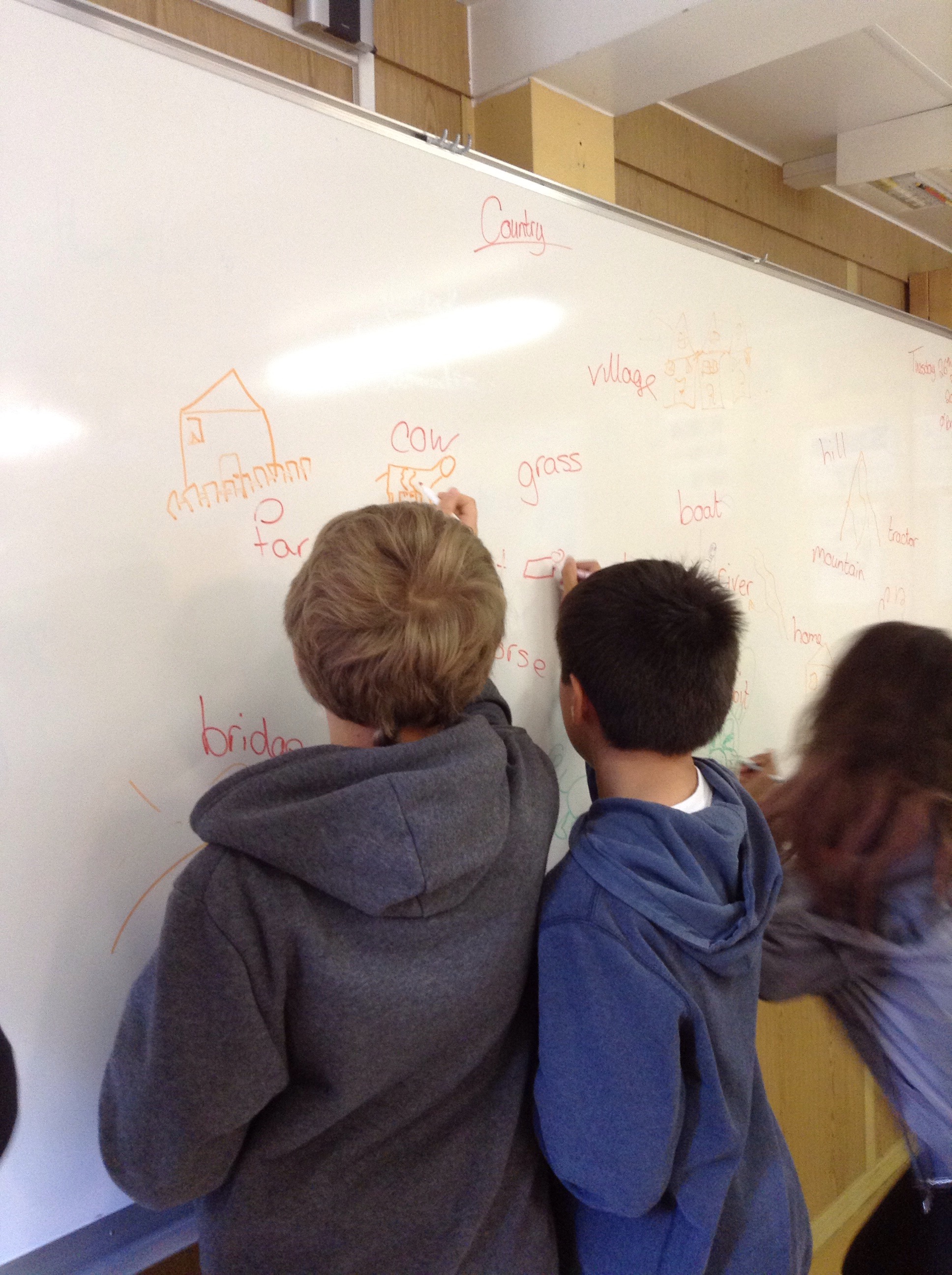
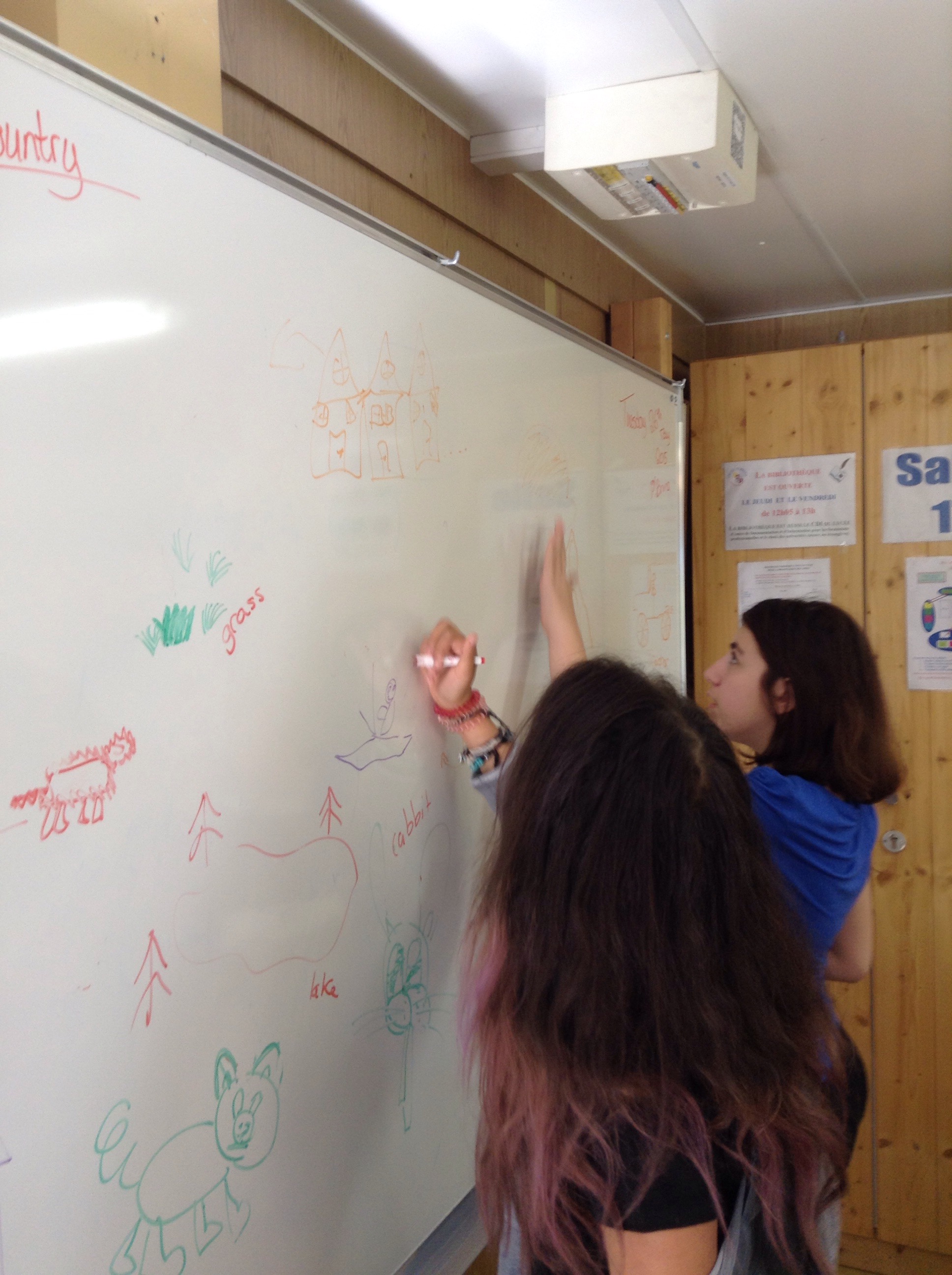
I try and start every lesson by asking students to recall words from last lesson, today I wrote up the words they called out and then asked them to come to the front to draw the images…

 
…then I wiped off the words and asked the students to label a picture that someone else had drawn.

 
Simple, quick and fun!

Please share your favourite ways of recycling vocabulary.  

Posted in Fab YL ideas | Tagged | Leave a comment

All the non-teaching stuff

I am busy packing my bag for a four-day trip to Lisbon with 48 students and a handful of colleagues, I’m really looking forward to this trip, and no, not because it’s a holiday!

It’s a great opportunity to get to know students outside the classroom, and I’ve found that often gives us a new insight into their characters, and I’m sure they could say the same about me!

Not only do we have time to chat about everyday things, but we also share new experiences, good ones like visiting beautiful places, but also more challenging ones like handling fatigue and delays.

Recently (after reading an article by Vicky Loras) I set up a book club, at first I wanted it to be in English, but I soon realized that the students who were interested in joining didn’t have the level to read the books that interested them (and me!) in English so now everyone can choose what language they read and discuss in, and I have found a load of people to shere my passion for YA lit with!


As you can see it takes place at lunchtime, thers’s a great atmosphere and I love talking about books I’ve enjoyed, but even more, I love seeing students really enthusiastic about something and sharing that passion. I wish I had filmed one really shy student last week, he hardly opens his mouth in class, but if you had seen him presenting his choice for next month, I’m sure you would have been as persuaded as I was!


I teach a first aid course to older students with a science colleague, this is probably one of the most important things these students will learn at school and hopefully one day a life will be saved because of these classes.

While all of these extra-curricular activities bring different aspects of learning to a non-conventional “classroom”, what I appreciate the most is that the students speak to me like a person, and not a teacher. This is perhaps how we can bring dogme to the secondary classroom, in any case it is language being used for what it was designed for; communication.

Posted in teaching journal | 1 Comment

I wish my students knew…

The other day I came across David Deubelbeiss’ post I wish my students knew… in which he flips Kyle Schwartz’ question to her students a while back that went viral; “what do you wish your teacher knew?”

As so often, David got me thinking, firstly about…

What I think they already know.

1. I’m pretty sure they know I love my job, I hope it’s obvious when I’m in the classroom.

2. They know I give presentations at conferences in Switzerland and abroad, including IATEFL, because I don’t shut up about it.

3. They know I go running, because when I’m out of sorts one of them will always ask if it’s because I didn’t go for a run at the weekend!

4. They know I’m mad about Star Wars because I use it in just about every example phrase I give, and they definitely know the new film is coming out soon because I’m always banging on about it!

5. They know I’ve got pets because they are the stars of many of my lessons.

6. They know I love YA literature because I’ve started a reading club at school so I can talk to someone about Divergent, An Abundance of Katherines, etc.

What I wish my students knew…

1. I wish I could tell them that I really couldn’t care whether they have a folder with all the lessons and worksheets I’ve given them in the correct order.

2. I wish I could tell them that if it was up to me I’d never give them another test, ever, ever!

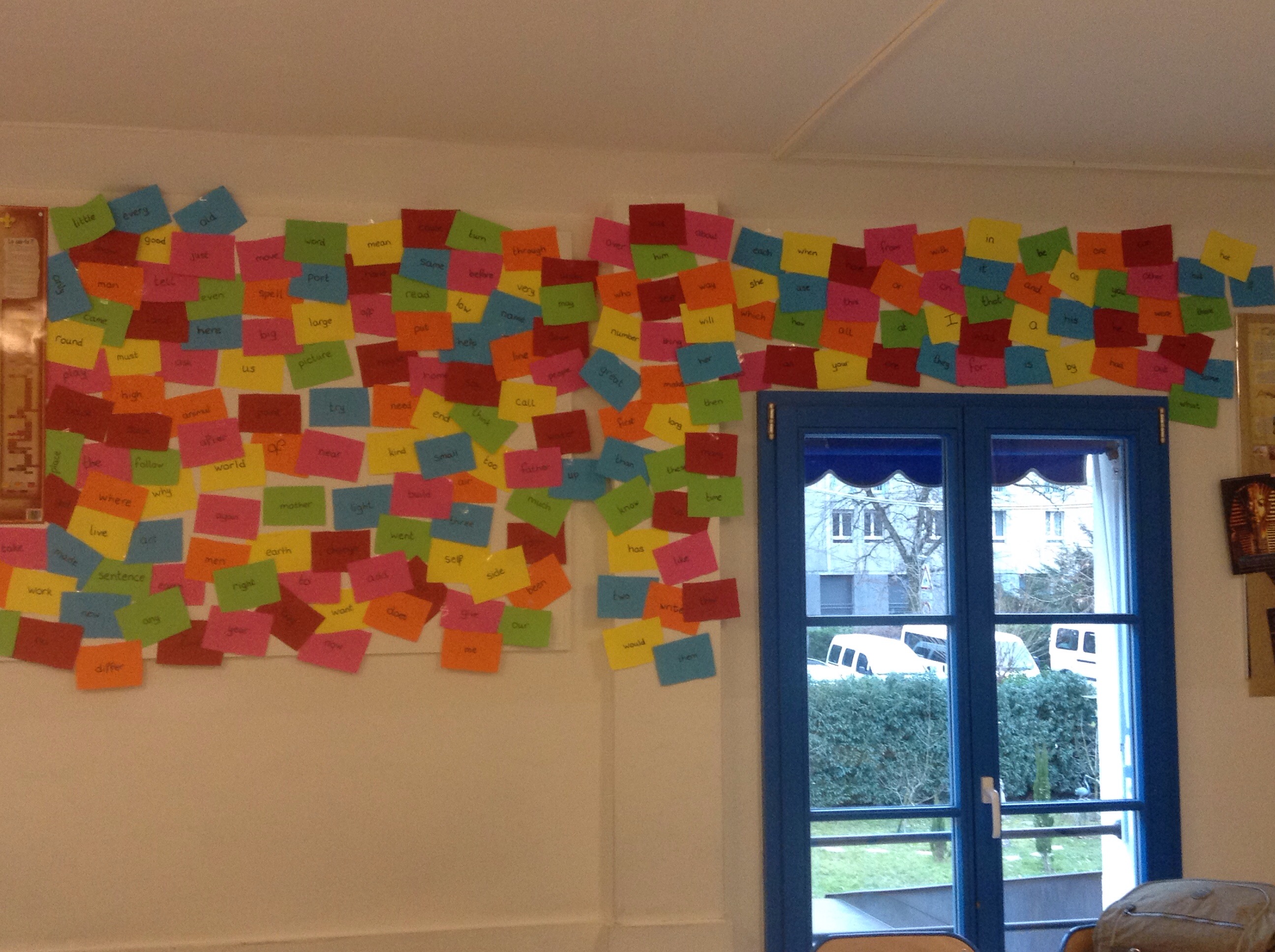
3. I wish I could tell them that I know one of them has added the word “tits” to my wordwall, but that I have pretended not to see it for the last month because it makes me laugh.

IMG_2558

But most of all,

4. I wish I could tell them that school doesn’t fit everyone, and that if it doesn’t fit them then they shouldn’t beat themselves up about it, they are still fantastic and will have fantastic lives and fantastic jobs.

Posted in survival tips, teaching journal | Leave a comment

How to give a successful presentation at a conference

Blogger-Manchester-150x150px-banner

This post is mainly based on Jeremy Day’s successful and entertaining presentation at IATEFL, with a few of my own thoughts and ideas tagged on.

Submit a Proposal: If in doubt go for it!This is exactly what I did and look where it got me!

Choose a Topic: Choose a subject that you care about, not  something just because it’s in fashion, – it won’t be anymore by the time your conference comes around. It’s also a great way of finding out a lot about a particular subject, there’s nothing more motivating to learning than talking about something to a group of teachers!

Choose your format: While some conferences have a fixed length for all their sessions, IATEFL differentiates between talks (30 mins) or workshops (45 mins), although the workshop is longer many first-timers prefer it because, with more participant intervention, it can feel less intimidating. Having done both at IATEFL I can tell you that 30 minutes goes VERY quickly, and most presenters seem to have trouble fitting their material into the allotted time. Whatever you decide on just remember that a workshop is not a talk and should include some group interaction, and to be honest a talk is livened up by just a couple of minutes “tell/ask your neighbour about…” as well.

Title & Abstract: Don’t be too clever and make sure you talk about what you say you will. Start with a controversial statement, or state a problem and how you will solve it. Some conferences (IATEFL) are very strict about title length (10 words maximum) and abstract length (50-60). These will be published in the programme and are what people rely on when choosing to come to your talk.

I’d also add that people want practical ideas they can put into practice, so say this in your abstract.

Summary: Here you will outline what you plan to do, and it’s what the conference organisers look at in their decision of whether or not to choose you (along with loads of other criteria you can’t do anything about, such as another 150 people offering the same talk or Scott Thornbury talking on the same topic). This should be 200-250 words and do not repeat the abstract, but go into more detail about what exactly you plan to do.

Planning: Think about what the audience want to hearI couldn’t agree more, even phrases such as “in my class we use posters for oral activities” can be improved by a quick change of perspective, “use posters” or “try using posters…” No matter how much we are interested in theory and research teachers still love to get a freebie activity to try in class.

Slides: Jeremy suggests one slide per three minutes or so,  I only had about six or seven this time (for 30 minutes) but with phrases appearing I suppose there was a change every three minutes or so.

Slides are NOT the presentation, they are a prop, although agreeable slides do add to a presentation. Marketing guru Seth Godin said no more than three words per slide, you can go a bit higher, I stick to the saying “no more words on a slide than a t-shirt”. Effects and animations are cool if you’re 12, after that, not so. I did actually see a presentation that featured fireworks in the slideshow, and thought wryly of Jeremy!

Hand Outs: If you are giving handouts then make sure they are brief and to the point, do your photocopies before as there is rarely the opportunity after you arrive. I gave my last couple of presentations as “paper-free” talks, I presented them as such and instead gave out my card for people to access this blog if necessary. Everyone seemed fine with that and it is easier than guessing how many participants you will have and either not having enough, or lugging a hundred-odd pages across the country or further.

I suggest less slides, if you are rushed for time (you probably will be) then you can always cut things you were going to say without the audience noticing, they will notice however, if you whizz through the last ten slides at lightening speed to get to your “Thank you” slide at the end!

Rehearse: For the audience and yourself. Especially yourself, you’ll be nervous enough anyway, and without sufficient practice you’ll forget half of what you wanted to say or won’t say it in the most effective way. Jeremy rightly suggests really focusing on the first five minutes, after that things will flow and from experience you’ll probably be to wrapped up in what you’re saying to look at your notes.

What can go wrong?: Everything, so plan for it! Especially internet, computers, jacks and convertors, etc. Aim high but be prepared to give your talk from your notes, and carry your notes and computer in hand luggage just in case! If you’re a mac user take every jack you can, especially VGA, this can make you very popular with fellow speakers who are not as on the ball as you!

Four Essentials:

Bottle of water – not only does talking make you thirsty, but a drink before will lubricate your voice, and a drink during can give you a necessary couple of seconds thinking time.

Tissues – you don’t want a heavy sneeze ruining everything!

Your notesas we said, don’t rely on the computer.

A clicker – looks much more professional, means you can wander about, and gives you something to hold on to, like a security blanket.

Your own computer – don’t rely on some unknown piece of technology, when I gave a webinar for Cambridge at the end of last year I had a nightmare when, just before it started I realised there was no ethernet connection on my mac, and then the computer I borrowed at the last moment was all “sticky” and the slides wouldn’t change when I clicked, a very sweaty-hand moment!

Nerves: Normal so don’t panic, the more you’ve practiced the less they will show, the audience won’t mind a bit of fumbling if your ideas are basically sound. Try and eat and sleep well in the week leading up to your big day, and the morning of the talk go for a walk, being outside and light exercise is great for stress.

A Good Start: Easy as A,B,C, (D)

Attention – get attention by starting with a story, a joke, controversial statement or an interesting image. I’ve noticed a lot of good speakers start with an anecdote.

Benefit – Be explicit about what the audience are going to get out of your session, as with good lesson objectives “by the end of the session you’ll be able to…”

Credibilitydon’t set yourself up as an expert, au contraire ” I’m not an expert but…” will win the audience over, but do explain your credentials, “I’ve used these activities successfully in my teens class…”

Direction – let the audience know where you’ll be going and what you’ll be doing during your presentation.

End with a quiz or some method of recycling what they’ve learnt during the presentation. I like to start with a question, and put it on a slide for participants to ponder over as they come into the room, and put it up again or refer to it at the end, it feels good to come full circle so to speak.

Please share your own nuggets of advice!
Posted in Conferences | Tagged | 2 Comments

IATEFL 2015 – Saturday

Blogger-Manchester-150x150px-banner

What a fantastic day! Six presentations and a plenary, but probably the best part, as always has been meeting such wonderful people from all over the world, in all kinds of teaching contexts. A great bonus this year has been all the ETAS people that I’ve bumped into, it’s a great conference anyway, but surrounded by people I know makes it even more special.

11149256_10204892986578402_4575442842274460034_n

I got there early to see Jeremy Day give a presentation on “How to give a presentation at an Internal conference”, I won’t go into too much detail because it merits a post of its own but I will say it was packed with useful and practical advice, and Jeremy cleverly added a practical example of what to do when the powerpoint plays up!

Carol Read welcomed us to the first plenary with a wonderful story,

“One day a mother mouse was out with her mouselets when hungry tom cat appeared in front of them, looking for trouble – or more precisely, lunch. The mouselets were obviously terrified, the end was obviously nigh. When suddenly mother mouse kept between her children and the baddie, and roared “WOOF WOOF!” The cat fled, and mummy turned to her children and said,

“Let that be a lesson to you my darlings, never underestimate the importance of learning another foreign language.”

Donald Freeman‘s plenary entitled “Frozen in thought” presented some interesting insights into TEFL myths, if my notes aren’t any use then don’t panic, it’ll be online pretty soon.

IMG_1302

Next was Ken Wilson‘s very entertaining “Only connect – 7 strategies for ensuring teacher-student communication.” Ken introduced ideas such as “sound of the day” – everyone make the sound “erh”, now make it sound happy/sad/wtf/etc.

He also suggested an interesting way of using the map of the book that pointless (as he pointed out) in dew at the front of the students book that they never read. Look at it with the class and ask them all to write a fact about one of the topics on a post-it, they then stick the post-it on the relevant page/unit and you can refer to them during the year as you reach these units.

After a well-deserved cuppa I dashed along to a YL panel facilitated by Vicky Loras, Juup Stelma, Sophia Magdalena de Stefani, Maria Muniz and Achilleas Kostoulas which dealt with interesting themes including the best age to start learning and how to develop ELT through project-based learning.

In the afternoon I saw Lisa Peter from the Shakespeare Birthplace Trust present their future sources website that will be opening on 23rd April ( the Bard’s birthday in case you didn’t know) at http://www.shakespeareresources.com. I’ll definitely be popping along to check that out as I’m about to start “Midsummer’s Night Dream” with one of my classes.

Next was fellow ETAS member Dina Blanco-loannou‘s talk on “Bloomifying tasks – how to develop thinking skills in task-based learning.” Dina not only gave us a lot of theoretical food for thought but also provided a detailed practical lesson plan, the proof of the pudding so to speak.

I could write loads more, but I’m off to prepare my talk for tomorrow, let me know what you saw and enjoyed.

Posted in Conferences | 2 Comments

IATEFL Pre-Conference Day

Blogger-Manchester-150x150px-banner

My first day at IATEFL 2015 was a YL & Teens bonanza, having never managed to get to pre-conference day before I didn’t know what to expect, although I thought it would be great and of course I wasn’t disappointed, despite only four hours sleep!

Firstly Joanna Budden told us a bit about the learnenglish teens website, I must recommend the magazine to my students – I’ve been looking for something to get the readerphobic students reading and this could be it!

She then went on to discuss various obstacles to learner-first learning, I was particularly interested in her ideas on digital obstacles, my students find it difficult to research information well, without resorting to copying wikipedia entries! Jo  showed us how to judge a wikipedia page and mentioned this TED talk – the Filter Bubble.

Jo also suggested avoiding the omnipresent google by using an alternative search engine such as duckduckgo and also pointed me in the direction of allaboutexplorers.com, a website with fake information that can be used for teaching digital safety, along the lines of the famous tree octopus.

I’m looking forward to sharing this with my colleague who teaches internet safety in our school, maybe I’ll add my own lesson to his.

I’m afraid I had to sneak off during Olha Madylus’ talk on what makes teens tick, so my homework for this evening will include checking out her blog.

Herbert Puchta was as warm and wonderful as ever discussing the importance of values in teaching teens, but it was Joe Dale who really shook us up at the end of the afternoon.

Joe showed us some great apps for moviemaking in the classroom, for some reason the wifi & internet are misbehaving so I can’t upload the films I made -probably something to do with a thousand or so teachers having descended on Manchester! However I’ll tempt you with the screen snaps of the following apps:

Tellegami-

IMG_1259

I hope you recognise me in front of the conference centre!

IMG_2756

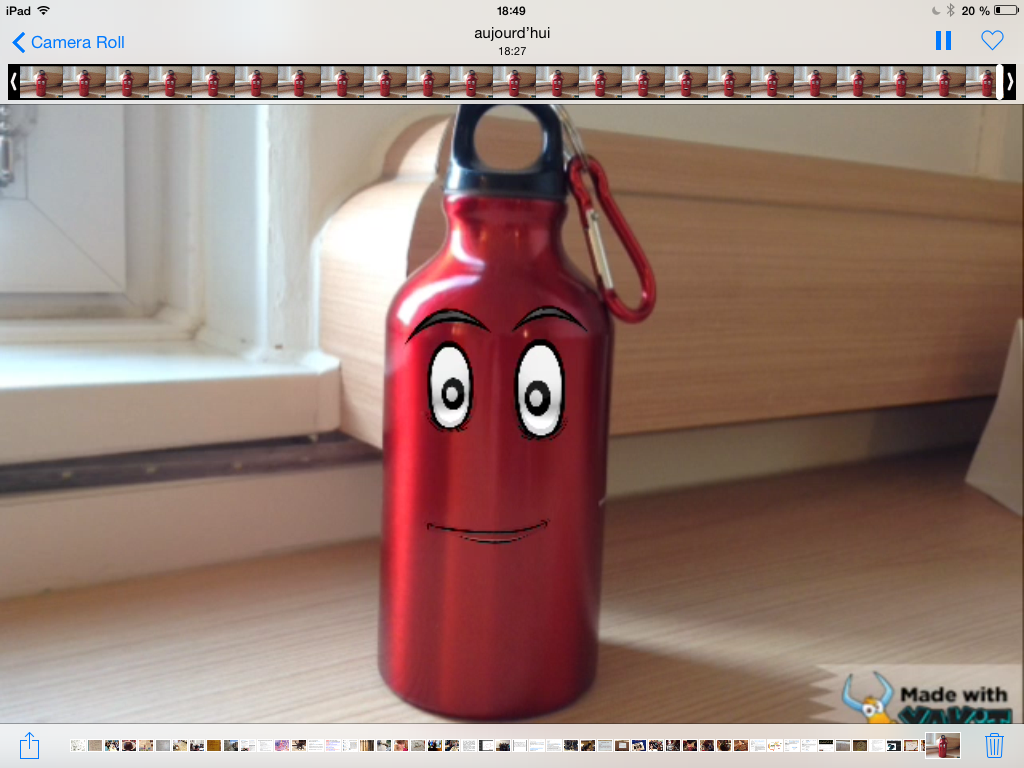
This is Yakit Kids, great for  funking up inanimate objects!

OK, I’m off to do my homework for tomorrow – see you then!

Posted in Conferences, Fab ideas, Fab YL ideas | 2 Comments

Essentials for Newbie #IATEFLers

Blogger-Manchester-150x150px-banner

The tension is mounting, I’ll be getting round to packing later today, and I’ll light another candle for those wonderful guys in French air traffic control who are bound to let my plane through later this evening!

Although I only went to #IATEFL for the first time last year I learnt an awful lot, here are some of the essentials I’ll be taking this year:

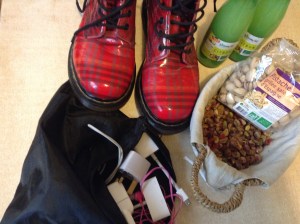
IMG_2714

1. Comfortable shoes 

Recently a conversation with colleagues turned to that well kown topic of “how to recognise an EFL teacher”, (see Nicola Prentis’ take for more details) and we came across the crucial sign – apart from the enormous bag that is, comfy shoes. I don’t mean that in a “Good Morning Vietnam” kind of way, but more in a “we walk miles” way.

Proof is that on a recent sightseeing trip to Lisbon I actually walked less than a typical day at school and you can ask my pedometer if you don’t believe me!

2. Snacks

With so much going on it’s easy to forget about brain food until it’s too late, so to avoid a hangry-driven mars bar overdose I always try and take some healthy-ish snacks to conferences.

3. Convertors & Cables

As a speaker I have nightmares about forgetting my jacks or convertor plug, it happened to the key-note speaker of a conference I attended recently! Also being an apple-addict I need extra jacks to compensate for the lack of useful entry points sleek design of my mac.

Being such a good girl, I’ve packed a spare of each so come and ask me if you haven’t!

Of course there are loads of things I’ve missed, notebook, clothes, etc. What are your essentials?

Posted in Conferences | Tagged , | 2 Comments

Bored with your Board 2 – the babyboard

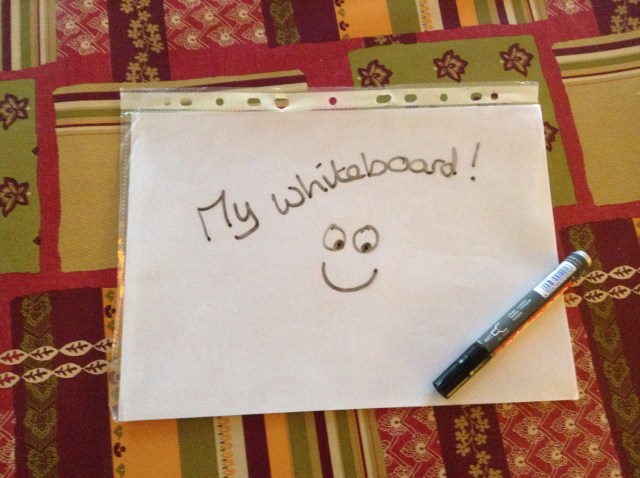
I’m actually lucky enough to have a set of mini-boards, a bit smaller than A4. Here in France kids need them for primary school and so I’ve a collection of various handmedowns from my children and their friends.

If you don’t have space/finance etc. for those then here’s the quick and easy way; just slide a sheet or two of paper into a plastic sheet and voilà!

We use them quite often in class to practice vocab and revise, some of the games we play include;

Pair Hangman – traditional but fun.

Guess my list – students write about four recently acquired words on their board, they take it in turns  to describe them to their friends – who must correctly guess the word, first pair to finish, wins.

Guess MY word – I describe a word, the students write what they think it is on their board, first one with the correct spelling gets a point for their team.

Pictionary – Students draw an image, neighbour guesses what it is.

Spelling practice – I (or their partner) say the word, they spell.

Private answering – rather than shout out, I ask the students to write their answers on their boards, this means everyone answers, the weaker ones can’t sit back and let the quicker ones do all the work, and it’s quiet – which is a nice treat sometimes!

Class Survey – rather than try and count a wave of rising and falling hands, when you ask a question to the class just ask them to write yes or no on their board and hold it up.

Writing Practice – students can do their draft version for short texts on these, easy to correct, saves paper.

Doodle – Students can’t help but doodle on their mini-boards, the minute I hand out the pens, flowers, hearts and emotions appear all over the place, but why not? It makes the students happy and keeps their workbooks looking smarter. Often I leave them out all lesson for particularly active students to draw on during other activities.

Save your photocopies– I always get students to put word searches, crosswords, revision exercises, etc. in these plastic sheets, they’re not the sort of thing you need to keep so why waster the paper?

What do you use mini-boards for? Please share your ideas!

Posted in Fab ideas, Fab YL ideas | 1 Comment

Bored of your Board?

Here are some ideas & tips for making the most of your board, be it black, white, green or smart – although to be honest I’ve never used the whiteboard more than since we got smartboards in our classrooms. While you’ll be familiar with most of them I hope there’s something new for everyone.

 A creature of habit

I always start the lesson in the same way, by asking students the date, the weather (for younger children) and what we did last lesson, a great way to recycle language and get everyone back into an “English class” frame of mind.

For older classes I write a historical event that took place on this day (which I get from the This Day app), these leads to a quick discussion on the event, or the students guess the job of the person if it’s something like “Joseph Lister was born on this day in 1827”.

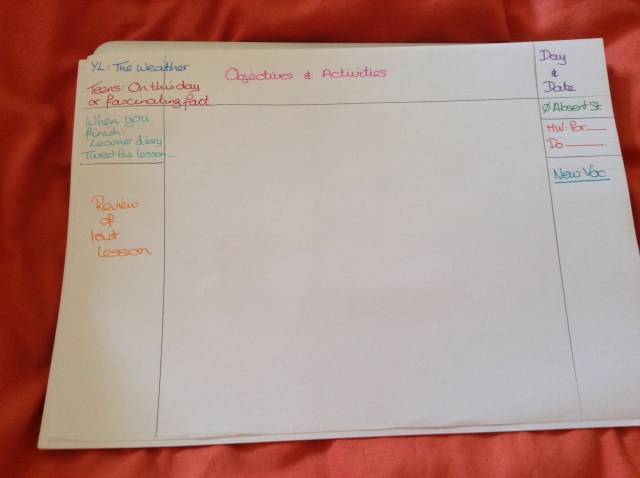
I then add the objectives and activities at the top and note absent students to one side, that way when I take a photo of my board at the end of class I have all the information I need.

Writing on the board

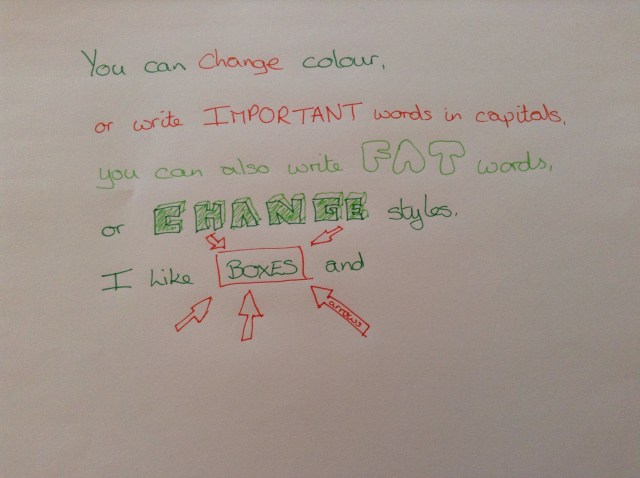
There are loads of ways to use the board, pictures of course, but writing styles too.

However save a thought for colour-blind students and those with learning difficulties. I avoid writing big chunks for students to copy, but if you do want them to copy then keep it simple and straight.

Split the board in two and start on the right side (if you are right-handed), that way students can read what you’ve written as you continue to fill up the left side – but make it very clear which side comes first, as it won’t be the logical left to right format they are used to seeing.

Remember to get the students writing on the board too. After a dictagloss or running diction for example, get groups to come up and write out parts, this saves the teacher’s attention for where it’s needed (see below) and also encourages peer correction.

Classroom management

If you do have to write for a prolonged period then set the students an activity to be getting on with, nothing sparks trouble like a class of students with nothing to do while the teacher’s back is turned!

Another idea to help classroom management is to write a riddle or quiz on the board before the students enter, they can be getting on with that while you do your start-of-lesson admin.

You can write a phrase promising a treat at the top of the board, for example ” We will sing a song at the end of the lesson”, wipe of a word for every piece of misconduct and only give the treat if they have a certain number of words left.

Writing the name of badly-behaved students on the board can also help, adding crosses that will result in a specific sanction helps too. A colleague of mine developed his own version of this, he would write the name of students who behaved badly in a list on the board, at the end of the lesson only the last student received the sanction, a good way to avoid blanket punishments!

Activities

The board is a great way for students to visualise language,

be it pronunciation or timelines.

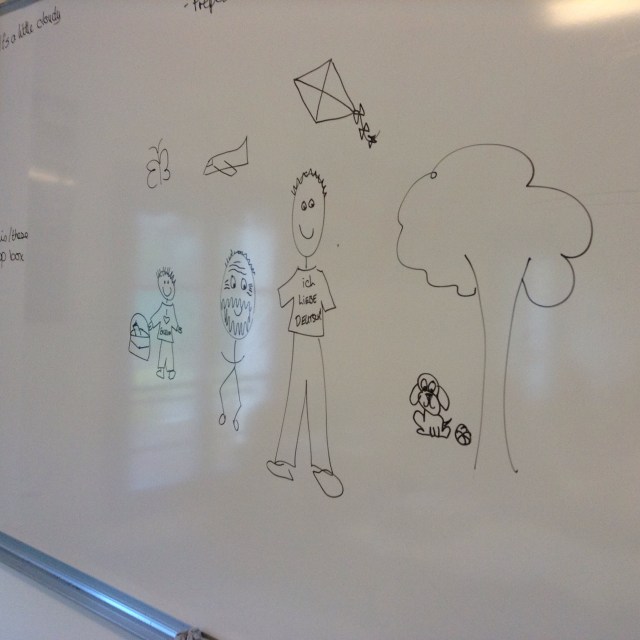
Some activities work particularly well, when studying prepositions, I draw a picture on the board that only half the class can see,

they must then describe the picture to their partner who is sitting with their back to the board…
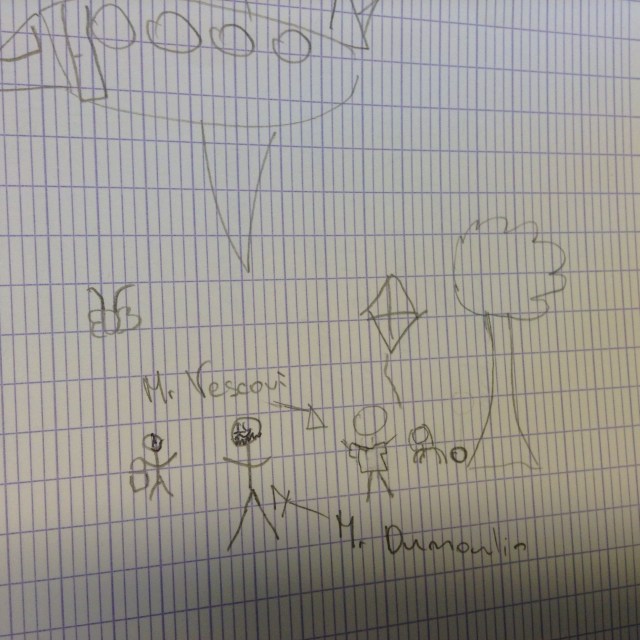
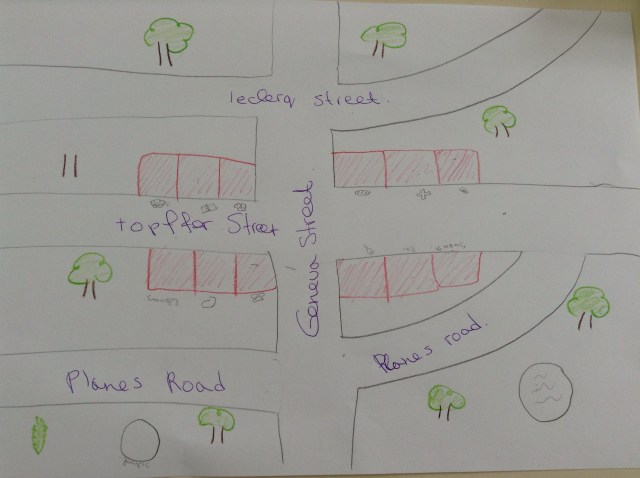
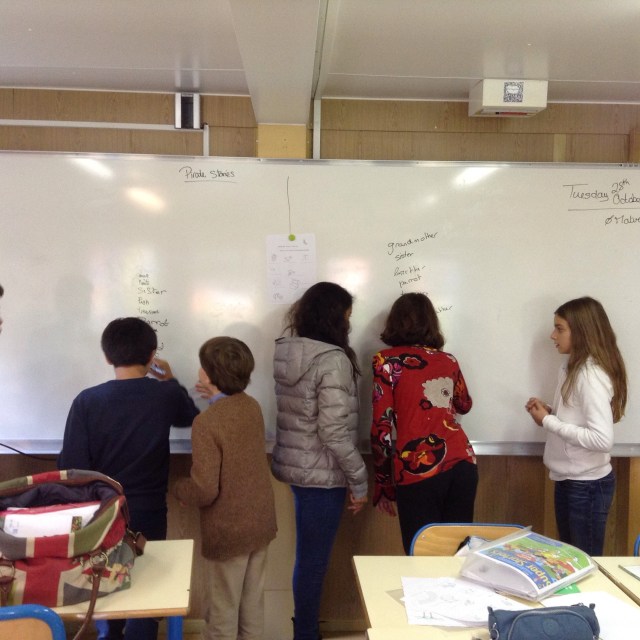
and finally we compare pictures – and laugh at how rubbish I am at drawing!

Other activities, such as giving directions work well with the board too.

Vocabulary

There are loads of vocabulary activities for the board, apart from hangman, Kim’s game works well ( this is where you draw a picture, students look for a couple of minutes, close their eyes while you wipe off or change something then call out what is missing), as does labelling – draw a body, or a fridge or wardrobe for example and get students to come up and label it or fill it in.

There’s something great about getting students up to the board, while it can end up a bit of a bun fight ( I quite like my lessons like that!) it’s great for giving students the feeling that they are playing an active part in their learning. It’s also a good way to change pace and give everyone a chance to move about – especially useful if you have an particularly active students who find sitting still for a whole hour a challenge.

You can also write words in stepping stones and students must make phrases to get from one side of the river to the other, or write new vocabulary in a ticktacktoe grid, the student who uses the word correctly gets to add their 0 or X in the place of the word.

Word creator – start by writing a letter, the class must then choose a following letter then it’s the teacher’s turn again, the first to make a word – teacher or class, gets the point, they really enjoying playing against the teacher – and win too often for my liking!

What about you? What are your favourite board tricks? Please share!

Posted in classroom management tips, Fab ideas, Fab YL ideas | 3 Comments