
What’s my CPD Story?

What is your story

(image taken from http://www.g-codemagazine.com)

When I read about Vicky Loras’  blog challenge here I decided to write about my own story, not my “how I came to be an au pair, fell in love with the region (and…!) and did a CELTA as speaking English was the only skill I had…” story but my CPD story.

After having done my CELTA so long ago that it was called a CTEFLA I entered the wilderness years. I taught at a language school where I was shown the book cupboard (which contained a few dusty copies of “Headway” and “Business Objectives”) and left to get on with it. A new colleague arrived and I was actually supposed to teach the girl a few things about teaching, me! So I showed her the book cupboard and left her to get on with it.

Thankfully there were a few forays out into the world of TEFL, a couple of workshops organised by ETAS, the English Teachers Association of Switzerland, then I discovered Penny Ur’s “Grammar Games and Activities” and my parents managed to find it in a book shop in the UK and send it me for Christmas.

The spread of the internet was the BIG BANG in my development as a teacher, living in a small village in France meant I survived on dial up connection for a painfully long time, you may be lucky enough not to know what this means so I’ll explain. A long time ago internet connection went down the phone line, so you had to unplug your phone to plug in your ethernet cable, you could then search for a page and go and make a cup of tea while waiting for it to come up. If you changed page you would also have time to put the washing out and clean the windows. As you can imagine my house was much cleaner back in those days!

Thanks to Amazon I was able to spend a frightening proportion of my salary on resource books, although as teaching is my passion and main hobby I’ve never really begrudged this. My CPD “road to Damascus” moment came about with the development of webinars, now I could finally attend all those wonderful workshops and seminars I’d missed, stuck in one of the most beautiful places on earth:

ferme pecheur

(image taken from https://www.facebook.com/LaFermeduPecheur?fref=photo)

Life continued it’s path for a few years, my lessons got slowly better thanks to an online diploma and organisations like ETAS and IATEFL. Obviously things were just too calm and so I decided to shake things up a little.

Just over a year ago I decided to send in a workshop proposal for the IATEFL Harrogate conference. I had never given a workshop or seminar before. IT WAS ACCEPTED!! I can still remember opening the email and screaming, I think my son will never forget that moment either.

Once I’d stopped hyperventilating I started organising myself. I needed to do a dry run, so I contacted Andy Hart, the Geneva regional coordinator for ETAS and he kindly let me do my workshop at the Bell school where he is director. This renewed my contacts with ETAS, which I had let slip over the previous few years, and I decided to put in a proposition for  different workshop for their PD (Professional development) Day in September, this was also accepted.

While I was at it I decided to send in an article on a similar theme (dyslexia in the language classroom) which was also accepted by the ETAS journal. Then things started to snowball, a lot. My contact with ETAS first included the editorial board of their journal, I’ve had to step back from this role however as I’ll be taking on the Teen SIG chair in the New Year.

I’ve also recently taken over from Andy as Geneva coordinator, and with a good friend; Karen, we have set up a regular teacher meet under the name of “teacherholics”, which perfectly describes our addiction to good practice in teaching I think. I also facilitated another workshop at TESOL Paris last month.

So basically in the last twelve months I have given four workshops, written three or four articles that have been or will soon be published, become Geneva regional coordinator and helped set up a teacher support group, and I forgot to mention I’m also helping Urs Kalberer (the present Teen coordinator) to put together a special supplement on TEENS for the ETAS journal next summer.

Next year so far –  In January I’ll be giving a workshop at ETAS AGM and taking over as Teens SIG chair and I’m giving a CPD afternoon workshop for my colleagues. I’ve been accepted to give another talk at the IATEFL international conference, this year in Manchester. We’ll be continuing our work on the summer journal, and organising workshops in Geneva with ETAS and Teacherholics. I’ll also be continuing my second year of the MA TESOL I’m doing with Sheffield Hallam university.

I can’t believe how much my teaching life has changed in the last fourteen months, it’s really a case of “he who dares…” I’ve learnt that if you don’t put yourself outside your comfort zone it’s very difficult to develop and grow, and boy, have I done that! It’s scary, but wonderful, I’m always telling my students that things are only worth doing if they’re a challenge, and here is my next challenge: I’ll be giving my first webinar with Cambridge English teacher next Wednesday!

Posted in teaching journal | Tagged | 1 Comment

How to reboot your CPD

I’ve just watched a recording of Fiona Dunlop‘s webinar for IATEFL, entitled “How to access your CPD“.

This, for me illustrates the availability of CPD today compared to when I started teaching, can you imagine it?- no internet, no blogs, no twitter, no amazon (*gasp*) and I hadn’t even heard of IATEFL.

Thankfully the wilderness years are over.

Fiona mentioned a variety of reasons for attending to your CPD, not that I need persuading, for me it’s definitely a question of the feel-good factor, that buzz you get when something goes *click-fizz* in the grey matter, not to mention that I believe in every aspect of life, if you don’t do your best then why bother doing it?

Fiona suggested some pretty amazing tasks:

Write down 250 of your achievements:

-250??? I can only get that many if I include getting to work on time every day this year! Actually she has a point, by including small achievements such as successfully dealing with a difficult student, detecting dyslexia in a pupil or not losing your temper in a difficult situation, you can build a very detailed profile of yourself as a teacher.

The next task was to choose twenty steps to achieve before the end of the year. This seems a lot with the end-of-year  rush so I chose 10, and tell someone about them (accountability is the key!), don’t worry I won’t bore you with them here.

SMARTER Goals

You know that SMART goals must be:

Specific

Measurable

Achievable

Realistic

Time-bound

SMARTER goals must also be:

Enjoyable – for me this is essential, I can’t believe no-one thought of it before!

Reflected- reflection on learning, and teaching is a very important, and often neglected part of CPD.

Now set yourself two SMARTER goals for the end of 2014.

Some simple CPD solutions:

-attend conferences

-attend local & in-house CPD events

-observation: peer, self, pop-in

-reflective journal

-online support

– write articles

-present at conferences

How to implement them:

-join IATEFL SIG groups

-join your national EFL group

-build it in to your routine

-set a goal and tell people

-watch a webinar

– check out calls for papers for your national EFL organisation and send in an article

– lead by example

– join a local group, and if there isn’t one then set one up

With all that, you should have some workable ideas on how to reboot your CPD, and some resolutions for next year!

Posted in Conferences, Reviews, survival tips, teaching journal | Tagged , , | Leave a comment

What a classy cocktail party! -Teaching exclamations

This week my class had been studying exclamations. I always find it a little artificial to teach phrases such as:

“How beautiful she is!”

“What on earth is that?”

when I haven’t met anyone who speaks like that in the last thirty years.

So how to practice it?

Luckily I had picked up a few ideas at the great workshop given by Elsien Gale (Activities to get teenagers speaking) at TESOL France a couple of weeks ago.

After presenting and practicing various forms of exclamations I asked the students to create their avatar. They chose names, nationalities, jobs, hobbies, etc. for their alter ego. After having moved the tables and handing out the all important props:

IMG_2148

I then explained that they had all been cordially invited to a diplomatic cocktail party at the English ambassador’s palace in Geneva. The students then had a few minutes to go round and introduce themselves (in their new character of course).

During feedback, they told the class who they had met and I encouraged a couple of exclamations form each student, and these seemed more “natural” so to speak while everyone was pretending to be part of “the upper crust”!

Posted in Fab ideas | 1 Comment

My TESOL FRANCE workshop –: L1 – How to avoid it and ways of using it in the language classroom.

According to Thornbury “ no other single issue in the history of language teaching has polarized opinion as much as the question of mother tongue use” (Big Questions in ELT, 2003)

History:

Ever since the Grammar Translation method fell out of fashion it has been considered a weakness or fault to use L1 in the EFL classroom.

Methods such as Krashen’s Monitor Method argued for massive target language input to acquire rather than learn a language.

The Communicative Approach and other methods made no mention of L1.

Many resource books (Harmer’s “How to teach”, Thornbury’s “A-Z of ELT”) make no reference to it.

Teacher training continues to advise against any use of other language in teaching English.

A little theory:

Deepti Jindal (2013): “Let’s Humanize Language teaching by using L1” asks the important question “Why do teachers feel guilty using L1?” and comes up with the following reasons:

  1. Students need exposure – yes, but only exposure of comprehensible language, otherwise it makes no difference at all, a child is exposed to approx. 10,000 hours of language before they begin to speak, are we assuming our students will also remain silent for the first two or three years of language class?
  1. Students must learn L2 in the same way they learnt L1, without explanations in another language – it is ridiculous to compare a business man learning English with a young child learning their first language, Vygotsky points out that language learning takes place in the proximal zone and is scaffolded by previous knowledge of language which will be based on L1.
  1. Students need to be encouraged to think in English – you can’t decide what language someone will think in, you know if you have learnt a foreign language yourself that you will automatically compare it to and contrast it with your own language, if you believe you can influence how people think, just sit & try not to think about white bears for a few moments.
  1. Interference errors– research shows that there are no more interference errors in classes that use L1. In fact this argument assumes that monoligualism is the norm, which is not the case, or that bilingual speakers do not regularly switch between languages, as is often the case.
  1. Translating will make learners feel both languages have exact equivalents– on the contrary, comparing and pointing out that in English you ARE your age, whereas in French you HAVE your age will help students avoid this error.

Research in favour of L1 Use

Auerbach (1993) questioned the “neo-colonial” element in refusing to allow TESOL students in the United States to use their L1.

Nation (2003) mentioned the harmful psychological effects in forbidding L1.

Also: A comfortable, safe atmosphere is essential in the language learning classroom, what better way to develop this than by a few jokes or a kind comment to a student who seems ill-at-ease? Also when teaching children for example, discipline in L1 seems to be much more effective than in English.

It seems the most important element in L1 use would be the teacher’s conscious decision of when and how to use it.

PRACTICAL WAYS OF AVOIDING L1

  1. Visual reminders– stick up a flag, use Puchta’s heart & E idea, use facial expression to show disapproval.
  1. Give them the necessary language – posters, useful phrase charts & lists, pre-teach necessary vocabulary before speaking activities, if a student speaks L1 get class in pairs to help him find English equivalent.
  1. Give them a safe place to learn & practice, be sure to be very careful & avoid correcting errors mid-flow.

4. Give them something to say – there are loads of great speaking activities about, use them.

  1. Rewards– piggy banks & fines, oral evaluation, sweets.
  1. Send out spies – can note L1 use & class can come up with English equivalent at end of activity.

7. Puchta’s poster – Our CLASS RECORD IS… post-it with days/hours or minutes …

  1. Ask students opinion – use questionnaire at start of year and get class to come up with rules & consequences concerning L1 use, often students don’t want it in classroom.

EFFECTIVE WAYS OF USING L1

  1. Instructions – sandwich L1 instructions by giving them in English before and afterwards, give instructions in English, get a student to repeat to class in L1, later try opposite – give instructions in L1 & get a student to repeat them in English for the class.

2. Comprehension Checks – orally, or give L1 summary of a text with mistakes to be corrected, give several versions of L1 summary & get students to choose the correct one.

  1. Translation games– consequences, Chinese whispers – choose a phrase from future text, popular song or quotation, using recent vocab or grammar point & get students to translate from L1 to English then pass it on and next student translates back to L1 and so on. Use Google translation to show possible errors that occur.
  1. Interpreter games– one student is interpreter, 2 others have “discussion” in given situation (bank, restaurant…), student interprets. Press conference – one student is star, class question him, either in L1 or English & interpreter must interpret questions and answers.
  1. Cultural awareness – often treats subjects above language level of students, code-switching/L1 maybe necessary.
  1. Learning Skills– important part of learning, again may be above students’ language level, vocabulary cards, etc.
  1. To avoid Burn out – especially in intensive or all-day courses, to brainstorm ideas before new activity, etc.

To conclude: L1 has a valid place in ELT classroom, however must be teacher’s choice – and teacher should lead by example, don’t expect your students to use English whenever possible if you slip into L1 at any opportunity.

Obviously multi-language classes or teachers in countries where they don’t know the L1 cannot use all of these activities, but that doesn’t mean L1 or multiple L1s cannot be used in variations of the activities proposed.

Posted in Conferences | 2 Comments

Workshop Review : Sophie Handy – Top Tips For Teens

In the first part of her talk at TESOL France this weekend Sophie described common factors of the various stages of “teenagerdom”:

11-13

  • girl/boy gulf
  • teacher approval still strong influence
  • world seen in black or white
  • new school =new challenges
  • physical changes starting & strong self awareness

13-15

  • SELF = most important thing in life
  • “nobody understands me”
  • girls are maturing faster than boys
  • group identity very important
  • independence Vs. security
  • developing an independent world view
  • strong opinions

15-17

  • physical growth more or less finished
  • boys have caught up with girls
  • girl-boy relationships develop
  • can work more independently
  • more tolerant
  • more confident in own identity
  • more differentiated world view, accept more grey areas

Sophie then went on to describe various forms of class disruption such as talking out of turn, not paying attention, not working, getting up and disturbing others, arriving late, etc., before giving the following clear, do-able tips to avoid these problems:

  1. Meet & Greet

Meet students at the door, greet them with their name and a smile, start each lesson afresh, standing by the door encourages them to calm down as they enter the room.

I would add here that it’s a good idea to have something written on the board that they can get on with immediately, the page number of a picture to describe, a quick warm-up exercise such as how many words can you make out of “SCARECROW”? or how many clothes can you name?

  1. Seating Plans

If possible then choose your own seating plan, “U” shapes work well for discussion activities, as do grouped tables, but discipline can be easier in a classroom where the tables are in rows.

Also draw up a plan of where each student is to sit within the class.

I would add here that it’s important to change a seating plan around from time to time, it’s not fair for well-behaved kids to be stuck at the back, or as buffers between more challenging students all year.

  1. Learning Objectives on the Board

This lets the students know what to expect and tells latecomers what they’ve missed. Starting with a fun activity as opposed to homework checking will stop students coming late (and also get the lesson off to a positive start in my opinion). When setting homework try and get the parents involved, i.e. find a family recipe to tell the class about next lesson. As Sophie pointed out, it’s good to get the parents on board in a positive manner, and not just contact them to complain about their child.

  1. Own the Room

Walk the walk and talk the talk, this is your space, be comfortable or at least fake it ‘til you make it! Another piece of advice I heard was to get into the ‘student zone’, their side of the classroom within the first ten minutes of each lesson, don’t stay hiding behind your desk.

  1. 5-4-3-2-1

When asking for quiet use this countdown technique, “5…still waiting for this side of the room…4… very good Claire…3…just waiting for these two to get their books out… etc.” to get silence by 0.

  1. Struggle to achieve meaning

Treat students with maturity, challenge them, get them to figure it out and flex their cognitive muscles a bit, with prediction tasks, “deliberate” errors etc.

  1. More carrot, less stick

Send home a positive note, use proximity praise (praising neighbours will make the student imitate their beahviour), give blanket awards not punishments, encourage team competitions, etc.

Giving the student a choice struck a chord with me, I feel it’s important to always give them an escape route, back them up against a wall and they have no choice but attack, for example “do you want to put that phone away now or give it to me?”

  1. Encourage Reflective Students

Let them reflect on their progress and successes, use two stars and a wish, this can be left on your desk anonymously or told to the class in a plenary.

This was a very informative workshop, full of useful ideas for what can be a difficult area in teaching teens.

Posted in Conferences, Reviews | 1 Comment

Review- Carol Read’s Plenary: Reflections on how to become a highly efficient teacher

Carol gave this fantastic plenary at TESOL France this weekend.

She started her plenary with the story of a woman who, furious that her plumber had charged her £50 for tapping on a pipe, asked for a detailed invoice…

INVOICE – tapping on the pipe = £5

  • knowing where to tap £45

I just loved this metaphor of the teacher’s job! I also enjoyed her remark about how we don’t suffer from information overload, but more from filter failure.

Carol added a fifth element to this conscious learning model:

IMG_2030

-complacence.

She went on to talk about how teachers are 20th century beings, teaching in a 19th century environment, to 21st century students, and described the change in teaching methods as a glide from “sage on the stage” to “guide on the side”.

Carol then presented her teacher development wheel, which looked something like this:

IMG_2032

M-MINDSET

The teacher’s mindset about how they see themselves as a teacher, but also developing a growth mindset with students by encouraging creative thinking.

R-RAPPORT & RELATIONSHIP

Matching and mirroring student behaviour in the classroom to create a positive relationship that is essential for learning to occur.

E-ENGAGEMENT & FLOW

She showed us this diagram:

IMG_2036

Where we can see high challenge and use of skills is necessary for flow, high but not impossibly high, a difficult balance to get right, especially in a group class.

S-SCAFFOLDING & SUPPORT

For both students and teachers

I-IMPACT

“They won’t remember what you said but they’ll always remember how you made them feel”, this quote from Maia Angelou is essential in my opinion, especially in the teen classroom.

L-LANGUAGE OF LEARNING

Quantify and describe learning, of the students and of the teacher.

E-EXPECTATIONS

Beware the self-fulfilling prophecy and always ‘demand high’ from all your students.

C-COLLABORATION

Between teachers, between teachers and students. Teaching cannot occur in a vacuum, nor can teacher development.

A very well-crafted and thought-provoking talk.

Posted in Reviews | 2 Comments

Workshop Review -Esra Girgin Gümüstekin – Teach Empowered

One of a series of workshops I saw this weekend at TESOL France.

Billed “to kick boredom out of the classroom” and “to motivate students to internalize the language” Esra showed us loads of fun activities, and woke us all up on a cloudy Saturday morning!

Magic Bag

Put a variety of objects in a bag, students tell a story involving the object, taking it in turns to pull an object out of the bag and continue the improvised tale.

Knot Story

A similar idea but without prompts, instead the students unwind a ball of wool, when the student comes across one of the knots that the teacher has previously added to the wool they hand it to another student to continue the story.

Don’t Step out

A fun activity for students who get on well together, put a couple of sheets of newspaper on the floor, enough so four or so students can stand (closely) together, give them all a flashcard of a recently studied lexical set, food for example. They should try to stand in a line, and as the rest of the class call out their favourite “carrot”, “beans” etc., they must shuffle around until the favourite is front of the line.

Find your partner

A great way to recycle phrases from a story or vocabulary, give out pairs of storycards or flashcards, students wander around repeating their phrase or word to each other until they find their “pair”.

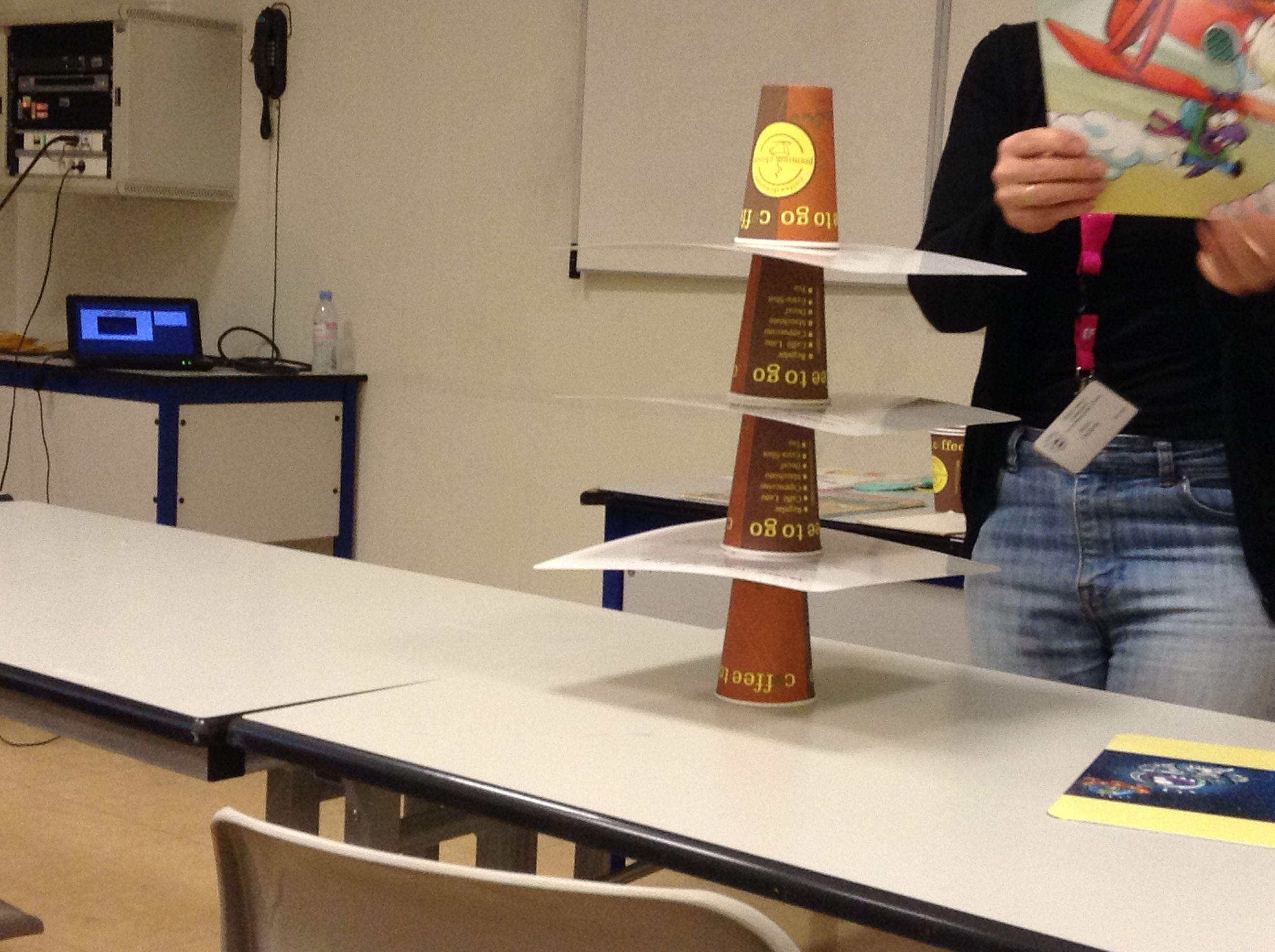
Cups Tower

IMG_2025

I’ll definitely be trying this idea out. Bring in a load of plastic cups, students balance a flashcard/storycard on the cup and say the word/phrase as they do so, another student comes up, places another cup on top of the card and adds another card, repeat until collapse!!

Only one word

The teacher asks a question and students can reply with only one word. I would suggest quick fire questions around the class, or pairwork to practice question forms.

No Yes, No No, No Nodding

A traditional favourite, but a great way of practicing question forms.

The flashcard games Esra illustrated made me regret my ipad flashcards, here are a few of my favourites:

STOP!

The teacher says a phrase including a word from a pile of flashcards, holding up the cards in front of her, she then put one behind the pile at a time, the class yell “STOP!!” when they see the word, if the teacher has that card still in her hand the class win a point, if not it goes to the teacher.

Post-it

Give a couple of students a pack of little post its, use different colours for each student. Stick up flashcards around the room. When you call out a word the first student to get his post-it on the flashcard wins, you can also do a variation of this using fly swats.

Bit by Bit

Turn over the top flashcard and slight it down very slowly, students call out when they think they know what the flashcard below is. You could turn them upside down to make this game more difficult.

Ostrich

Students stand in pairs facing each other, give each one a flashcard that they hold in both hands behind their back. The objective is to see and call out your partner’s word before they see yours.

This game was great fun, I can’t wait to try it!

On the whole a great workshop that really woke us up  and a perfect start for my TESOL France 2014.

Posted in Reviews | 3 Comments

What I learnt today: Engaging Young learners with Content, Language & Learning Skills

Today I went to a workshop led by Jane Maria Harding da Rosa who blogs at jmhdr.wordpress.com.

When she said we learn by teaching, I knew she was talking to me! So here are some of the things I learnt today:

The workshop was entitled “Engaging Young Learners with Content, Language and Learning Skills”.

The objectives of this workshop were to familiarize teachers with the idea of using content and learning skills to aid language development, to provide practical ideas and activities for using content and learning skills in the classroom, and finally to link these activities with Cambridge YL examinations.

Jane used a variety of activities that were new for me, including a ranking diamond (more effective than a list as it allows you to choose “best” and “worst” but leaves equal positions in the middle) and wall stations (which I do use, but these were folded sheets so the team members had no choice but to explain to their team, instead of the rest of the group looking over people’s shoulders and reading for themselves!) to explain to those present what was meant by deep cognitive engagement.

She illustrated activities such as chant creation and flashing images (that students must memorize) that could be used to develop this in the young learners’ classroom. We discovered the difference between function words which tend to be learnt incidentally, and content words that are taught in more planned ways.

Learning skills were introduced by looking at how children learn their first language, and the mnemonic device CREAM reminded us that language learners need Context, Repetition, Experimentation, Association and assimilation Meaningful input.

Jane explained the difference between homework and home-learning, I thought this was great and she also gave some useful examples of the latter, for example asking students to think in English for five minutes, by looking out of their window for example and naming all the things they can see, adding adjectives, verbs, etc. Another fun practice activity she presented involved drawing a face on one of our fingers and creating a personality and background for this new “character”, we enjoyed creating discussions between our new “friends” and it was easy to see that this would be a popular classroom activity that could be extended in home-learning time.

One of the key points Jane made was the importance in encouraging fluency in what our students know, rather than continually giving new language to be learnt, I really agree with this and then she suggested many simple and effective activities involving word cards that did just this, such as labeling, a version of happy families called Go –Fish, as well as memory games, etc.

In the final part of the workshop we put into practice the many activities that had been presented, choosing which were most suitable for the various parts of the Cambridge Young Leaners’ examinations. I particularly enjoyed the idea of cutting a small hole in a piece of A3 paper, placing it over an image, and moving it about so the students can slowly guess and describe the subject of the image.

I particularly appreciated Jane’s methods of “reflection on reflection”, whereby throughout the event we were encouraged to think about what we had learnt so far, not only did this anchor the many new ideas for us participants, but it was a great example of what we should be doing in class to recycle and anchor learning. She also used a “thumbometre”, where we did thumbs up-midway-down to show our understanding of the concepts she explained. This activity could easily be done in class, with thumbs on chests this could be quite discrete, showing the teacher where we are in our learning without letting the rest of the class know.

To conclude, this was a well-organized and information packed workshop (thank you ETAS/Cambridge Geneva-Vaud!), with plenty of group work and games to motivate the tiredest of teachers on a Saturday morning, and I’ll definitely be looking at Jane’s blog jmhdr.wordpress.com for even more ideas!

Posted in Reviews | Leave a comment

A webinar review : Herbert Puchta – Motivating Teens through activating their brain’s own reward

Today I watched Puchta’s webinar on the Cambridge English teacher site, if you aren’t already a member of this excellent organisation the I would advise you to join it, they have courses, webinars and advice from experts in various fields including Nicky Hockley and Penny Ur.

As always, I learnt best by telling someone else about it afterwards, so here is what I learnt today:

Motivation is probably the single most important psychological factor in learning, especially for teens.

Puchta described various psychological experiments that I was familiar with from previous studying, including Glucksberg’s famous incentive experiment involving a candle, a box of drawing pins and a box of matches.

These various experiments show that while external incentives are effective for mechanical skills, the opposite is the case for cognitive skills.

This basically means that carrots and sticks work with dogs, dolphins and pigeons, but they don’t work with language learning. Students need to reward themselves and in this their brain’s emotional system plays an essential role.

Positive emotional experiences produce dopamine (pleasure), adrenalin (excitement) and seratonin (calm) in the brain. Negative experiences ignite the “fight or flight” reflexes in the amygdala area of the brain.

Language learning is cognitively challenging, this means success will set off the brain’s reward systems, while failing to communicate in a foreign language will lead to frustration and set off the negative emotional system.

Fortunately we can influence intrinsic motivation and Puchta went on to explain 4 key principles to do just this:

1. Understanding– this is necessary for survival, and leads to a feeling of satisfaction.

2. Relevant content – It is important to choose topics relevant to students’ lives.

3. Give students a sense of control

4. Action/movement – it is important to set achievable goals and for students to feel they are moving towards these objectives.

Practical Implications of these principles:

This doesn’t mean teachers should never praise students, everyone needs recognition and rewards are a useful first step towards self motivation. However not all praise or forms of rewards are useful.

1. Use positive feedback rather than praise

Explain what was good and why, be specific “I liked it when you used adjectives such as…” I also think it is important to praise work and effort, rather than just the finished version and always make a point of shouting out to students who work hard. Puchta referred to Dornyei’s suggestion to thank students for their participation and to celebrate their efforts – any excuse for a class party wins my vote!

2. Help students become aware of their learning progress

Puchta mentions Jim Scrivener’s suggestion (from his excellent book Classroom management) to make achievements visual using wall displays, checklists, posters etc.

3. Engage Students in goal-orientated action and give them the opportunity for anticipated movement.

I agree that it is important to share lesson’s goals with students, I do this by writing up the day’s objectives on the board and referring back to them during the class to keep students on track (it also lets them know how long to go until the next break!)

4. Help students feel they have ownership 

When answering questions at the end of the webinar Puchta came back to this point,  problems can occur in the teen classroom because the teacher is boss, and students resent their lack of power. This doesn’t mean letting them do what they like, but when possible let them choose – “do you want to do the reading comp or the listening first?” In my classes I always offer the choice of the day for the test or to hand in an essay, it makes no difference to me if it is Monday or Tuesday for example, and it means I only rarely have a student asking to change the date – after all, it was their decision.

5. Use Relevant content

Obviously students work better with topics they see as interesting or important, recently we’ve been looking at how to give directions on the London tube, one student asked if it was the real map we were using, he was very motivated to find that it was and that I could tell him which stop he needed for the London Eye and Mme Taussaud’s.

6. Challenge them, but not too much

As previously mentioned failure is frustrating, success is rewarding in itself.

7. Use incentives in a light-hearted way

This part caught my attention as I give each student who gets 20/20 a sweet, at first some sneer, but don’t worry, they are quick to reclaim their prize when they get 20! However Puchta suggests giving rewards after good work as a surprise, rather than before, to avoid  ineffective if…then… extrinsic motivation.

I found this webinar informative and interesting, it’s always reassuring to hear you’ve been doing something right in class, while at the same time learning more about background theory and practical uses for it.

Posted in Reviews | Leave a comment

Some ideas on how to effectively use L1 in the EFL classroom

Used well, your students first language has a valid place in your EFL classroom. Here are some ideas of activities to incorporate L1 into your lessons:

1) Translation Consequences

Take a piece of paper for each student and give them a phrase in English, using recent language acquisitions, or ask them to write their own.

Next get them to translate these phrases into their L1 (make sure this will be the same for at least pairs or groups if not the whole class) and fold the paper to hide the original phrase.

The students then hand their paper to their neighbour who translates this L1 phrase back into English.

You can either continue this until the page is full or stop here, open the paper and have the students discuss any differences.

2) Interpreter Game

Their are many variations for this activity, and as interpreting for family and friends while on trips or when they come across English is actually something my students regularly do, they find this activity useful, and fun.

Put the students into groups of three and give them a situation, for example in a restaurant, bank, hotel. One student speaks only L1 and the “interpreter” must interpret for the English speaking waiter/receptionist etc.

Alternatively try this whole-class activity- one student chooses which superstar he will be (or you can choose someone who you studied recently or who is in the news). The rest of the class are journalists and they are interviewing the star at a press conference, you can choose whether the star or the journalists speak L1 and, as before the interpreter has to translate the questions and the answers.

3) Subtitles

My students love watching films in class, however I am always keen to ensure these lessons remain learning experiences and don’t fade into time out with no apparent objective. One of the activities we do is watch a small moment of film in English (with English subtitles if necessary), get the students to write their own subtitles in L1, then watch it again with L1 subtitles and compare them to those the students wrote. It’s interesting to compare the two forms of subtitles as well as the difference between the spoken dialogue and written forms.

4) Comprehension Check

As well as simply checking orally that students have understood a written or oral text, I give summaries in L1 with some intentional errors, and ask them to correct them. Alternatively give two or three versions and have the students choose the correct one.

5) Grammar Translation

Shock, horror! Dare I actually suggest this method to fellow teachers in this day and age?!! Well, yes actually. Recently I was explaining to a year 7 class (first year of L2 for many of them) that in English we use BE to talk about age, as in French they use HAVE it was logical to mention this. As many of my students speak other languages, this developed into an interesting discussion about how to talk about age in Russian (neither BE or HAVE apparantly), Finnish and Khazak. I’m not suggesting using it all the time, but as in this case I wanted to draw attention to the difference between English and French it was a useful exercise.

6) Learning Skills

Teaching in a secondary school, I spend a lot of time, especially at the beginning of the year, talking to students about how to learn. It seems this (in my eyes essential) part of the school curriculum is missing in other classes, and I give them useful tips on how to go about learning vocab and revising for tests, in all their classes, not just English. These discussions are usually in L1, especially for lower level classes, although they are repeated regularly, and sometimes in English, during the school year.

There is a valid place for L1 in the EFL classroom, and by defining and thinking a little more deeply about this place I actually find students are more willing to communicate in English at other moments.


Posted in Fab ideas | Leave a comment